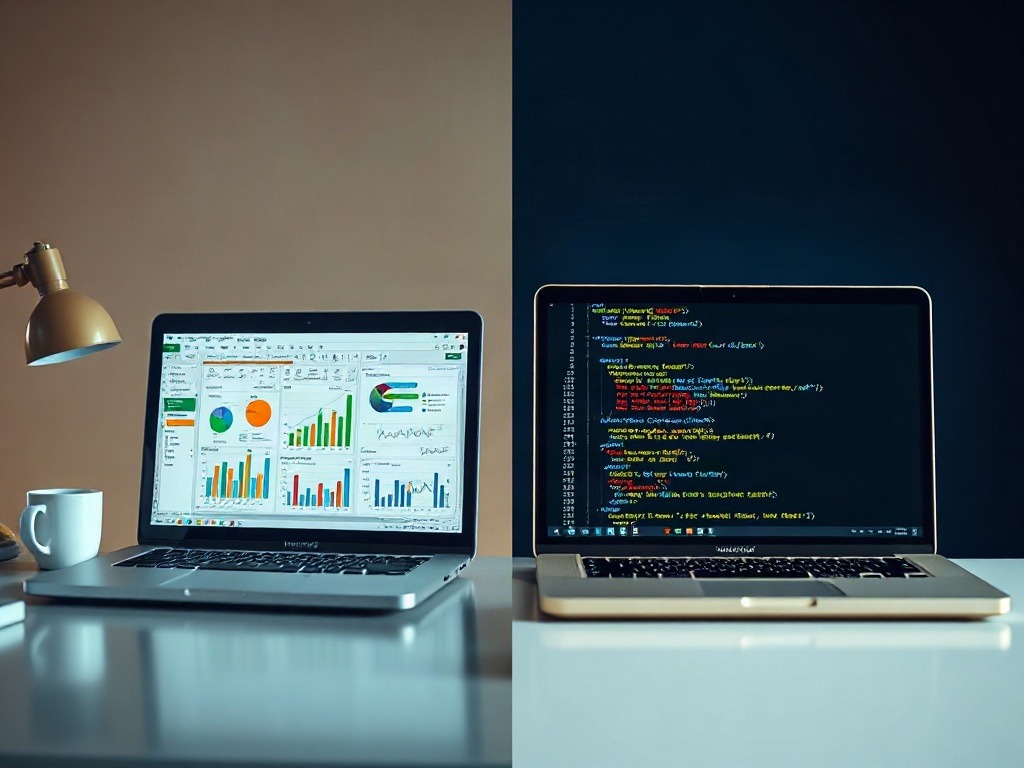
I spent two years learning Excel inside out before touching Python. Two years. Pivot tables, VLOOKUP, array formulas, the works. I could build entire financial models in a spreadsheet that would make seasoned analysts nod approvingly. Then I joined Morningstar, and within three months, I realized I'd been building sand castles.
Not because Excel is useless — it's the opposite. But because I'd learned in the wrong order, and the gap between "Excel expert" and "someone who can actually automate and scale their work" felt like jumping across the Arabian Sea with a running start.
This post is about what I got wrong, what I finally understood, and what you should actually do if you're sitting where I was — staring at two paths and unsure which way leads somewhere real.
What I Got Catastrophically Wrong
I genuinely believed Excel mastery was the ladder I needed to climb. Here's why that felt true at the time:
Every financial analyst I knew in Kalyan used Excel. Every job posting said "Expert in Excel" somewhere in the requirements. Every training course I could afford cost ₹5,000–₹8,000 and promised to turn me into an "Excel wizard." So I bought Udemy courses, spent weekends practicing, and even built a side project tracking mutual fund returns across multiple portfolios (all in Excel, of course).
The belief was simple: master Excel first, because Python is for software engineers, not finance people.
The False Confidence Phase
By the end of year one, I could do things in Excel that impressed people at family gatherings. I could pull data from multiple sheets, create dashboards with conditional formatting, even write basic macros in VBA. When friends asked me about their Zerodha portfolios or CRED credit scores, I'd open a spreadsheet and build them something custom. They'd think I was a wizard.
But here's what I wasn't doing: I wasn't solving real problems at scale. Every analysis took hours. Every new request meant rebuilding formulas. If a dataset had 2 million rows instead of 20,000, Excel would literally choke. I just didn't see it yet because I wasn't working with real datasets.
The Breaking Point
Three months into my job at Morningstar, I was asked to analyze fund performance across 500+ portfolios and identify patterns in investor behavior. The data was clean, structured, and about 50 GB in size.
I opened Excel.
It crashed.
I tried again with a filtered subset. Still crashed. My senior analyst, who was kind enough not to laugh, pointed me toward Python and said, "You're going to need this."
That was my wake-up call. Not because Excel is bad. But because I'd chosen it first, thinking it was the foundation, when actually it should have been the companion tool.
Why Learning Order Actually Matters
Python First Gives You the Mental Model
When you learn Python first, you learn how to think like a programmer. You learn about loops, conditional logic, functions, and data structures — not as Excel buttons, but as fundamental concepts. You understand that a loop is a loop, whether you're writing it in Python or SQL or anywhere else.
Excel hides these concepts behind a user interface. You can do powerful things without ever understanding the logic underneath. That's fine for quick calculations, but it's terrible preparation for real analytical work.
When I finally started learning Python (four months after joining Morningstar), the difference was shocking. Concepts that should have taken weeks to grasp clicked in days because I already knew them — I just didn't know I knew them.
Excel Then Becomes Practical, Not Fundamental
Once you understand Python, Excel stops being a challenge and becomes what it actually is: a tool for quick, small-scale analysis and presentation.
I still use Excel every single day. But I use it after Python has done the heavy lifting. I'll write a Python script to clean and process 2 GB of fund data, export it to CSV, and then open it in Excel to create a presentation-ready dashboard. Excel is the final 10% — clean, visual, stakeholder-friendly.
But it's not the foundation. The foundation is knowing how to think computationally.
The Current State of the Indian Analytics Job Market
Full transparency: I was wrong about job requirements too.
When I was job hunting in 2019, I saw "Expert in Excel" on nearly every listing for data analyst roles. But I didn't notice something: every single posting also said "Knowledge of Python or R preferred" — and I skipped over that because I thought it was optional.
It wasn't. It is never optional anymore.
Here's what changed, and what it means for you:
| What the Job Market Actually Wants (2024) | What It Looked Like in 2019 |
|---|---|
| Python or R is essential; Excel is assumed | Excel is essential; Python was "nice to have" |
| Automation and scripting are baseline expectations | Ability to build complex formulas was impressive |
| Can you work with APIs and databases? | Can you use VLOOKUP and INDEX-MATCH? |
| Real candidates at startups (Zerodha, Groww, Razorpay) all code | Real candidates at banks all knew pivot tables |
Startups like Zerodha, Groww, and Razorpay hire data analysts who can code. Banks still have people who live in Excel, but even that's changing — they're hiring "data engineers" instead, and those roles require Python.
The gap I had to jump is the gap you should avoid entirely. Learn Python first.
Python First: A Realistic Learning Path
Here's what I wish someone had told me. Not a perfect path — just a real one, from someone who's actually lived it.
Months 1–2: Learn Python Basics (3–4 hours per week)
Not "advanced Python." Not "Python for data science." Just basic Python. Variables, loops, functions, lists, dictionaries.
Use free resources: Codecademy, YouTube channels like Corey Schafer, or even the official Python docs. Don't buy courses yet. Just get to a point where you can write a simple script that solves a problem — like reading a CSV file and filtering it.
Time investment: ₹0. Effort: Real, but not overwhelming. You can do this while commuting (well, not while driving, but on the local train from Kalyan to Mumbai, absolutely).
Months 3–4: Python Libraries (Pandas, NumPy)
Once you know basic Python, learn Pandas and NumPy. This is where the magic happens for data work. Pandas is basically Python's version of Excel, except it's actually powerful.
Do mini-projects: download a Zerodha CSV, analyze it with Pandas. Pull your mutual fund data from CRISIL or ValueResearch, clean it, summarize it. Real projects, real data, zero stakes.
Time investment: ₹500–₹2,000 for a focused course (I'd recommend Krish Naik's stuff or even some of the coursera options), or stick to free YouTube. 5–6 hours per week.
Months 5–6: SQL Basics
By now you should start learning SQL. Not advanced SQL, just enough to query databases. Most real-world data doesn't live in CSVs — it lives in databases.
This is the point where Excel finally becomes relevant, because you'll realize: "I could do this in Excel, but I can't because the data is too big." That's when you'll actually want Excel as a complement, not as a foundation.
Time investment: 3–4 hours per week for 4–6 weeks.
And honestly? Only after this foundation is built should you go back and systematize your Excel knowledge. By then, you'll use it differently.
What Excel Is Actually Good For (Real Talk)
I don't want to trash Excel. It's a phenomenal tool. I use it daily. But it's not a foundation — it's a finishing tool.
Excel is perfect for:
Quick calculations on small datasets. If I need to calculate returns on my personal SIP investments (I have a small portfolio in Groww and HDFC Mutual Funds), I'll do it in Excel in 10 minutes. Python would take longer because I'd have to write a script.
Building dashboards for non-technical stakeholders. Your CEO doesn't want a Python notebook. They want a clean, visual spreadsheet they can open and understand immediately. Excel is the medium.
One-off analysis when you're exploring. If someone asks you, "Hey, what's the average return across these 50 funds?" you can throw it in Excel and get an answer in seconds.
Combining data from multiple sources. When you need to pull data from a CSV, an API response, and a database query and merge them? You could do that in Python (and you should for large operations), but for a small, one-time merge, Excel works fine.
But none of these are things that require Excel to be your first skill. They're things that make Excel useful once you already know how to think computationally.
My Perspective: The SIP Decision I Got Wrong
I want to be honest about something specific because it connects to why I made the Excel-first mistake.
Around the same time I was doubling down on Excel, I also decided to put ₹5,000 per month into mutual funds through a CRED SIP. I told myself it was a "boring but safe" choice. No need to understand how markets work or risk management — just automate and forget.
But I couldn't actually analyze my own portfolio meaningfully. I could track returns in a spreadsheet, but I couldn't answer real questions: "Am I diversified? What's my actual risk exposure? Should I rebalance?" I was just watching numbers go up and down.
Learning Python changed that. Within a month, I'd written a script to pull my portfolio data, calculate correlations between funds, and flag concentration risk. I couldn't have done that in Excel — not meaningfully, not at scale.
That's when I realized: I'd chosen Excel because it felt safer, more familiar. But safety is just another word for limitation. The tools that actually solve problems — Python, SQL, databases — felt harder. So I avoided them.
I regret the two years I spent on Excel. Not because Excel was useless. But because I built a skill that looked impressive but couldn't scale to real problems. If I could rewind, I'd learn Python first and learn it properly. The Excel would come naturally, and I'd have solved better problems along the way.
Final Thoughts
Here's the simple version: Learn Python first.
It's not because Excel is bad. It's because Python teaches you to think in ways that make you better at everything — including Excel. The reverse isn't true. Being an Excel expert doesn't teach you Python or computational thinking.
If you're 22–25 and have 6 months of free time (or even 10 hours a week over a year), invest it in Python. Not because it'll look good on your resume, though it will. But because when you hit a problem that Excel can't solve, you won't be stuck. You'll know what to do.
The commute from Kalyan to Mumbai is perfect for this, by the way. Listen to Python tutorials on the local train, practice problems during lunch, build a small project on weekends. By the time you're job hunting, you won't be choosing between Excel and Python. You'll be choosing between different jobs.
And if you're already deep in Excel and feeling stuck? Don't feel bad. You're not wasted time — you're just walking the path in the wrong order. Start Python today. The sooner you do, the sooner Excel becomes actually useful instead of just impressive.
You've got this.
Dattatray Dagale
Data Analyst • Blogger • Mumbai
I'm a data analyst from Kalyan, Maharashtra, working at Morningstar. I write about personal finance, career growth, and everyday life for Indian millennials — the stuff I wish someone had told me earlier.
Written by Dattatray Dagale • 02 October 2026





.png)

.gif)


0 Comments