Last month, I counted.
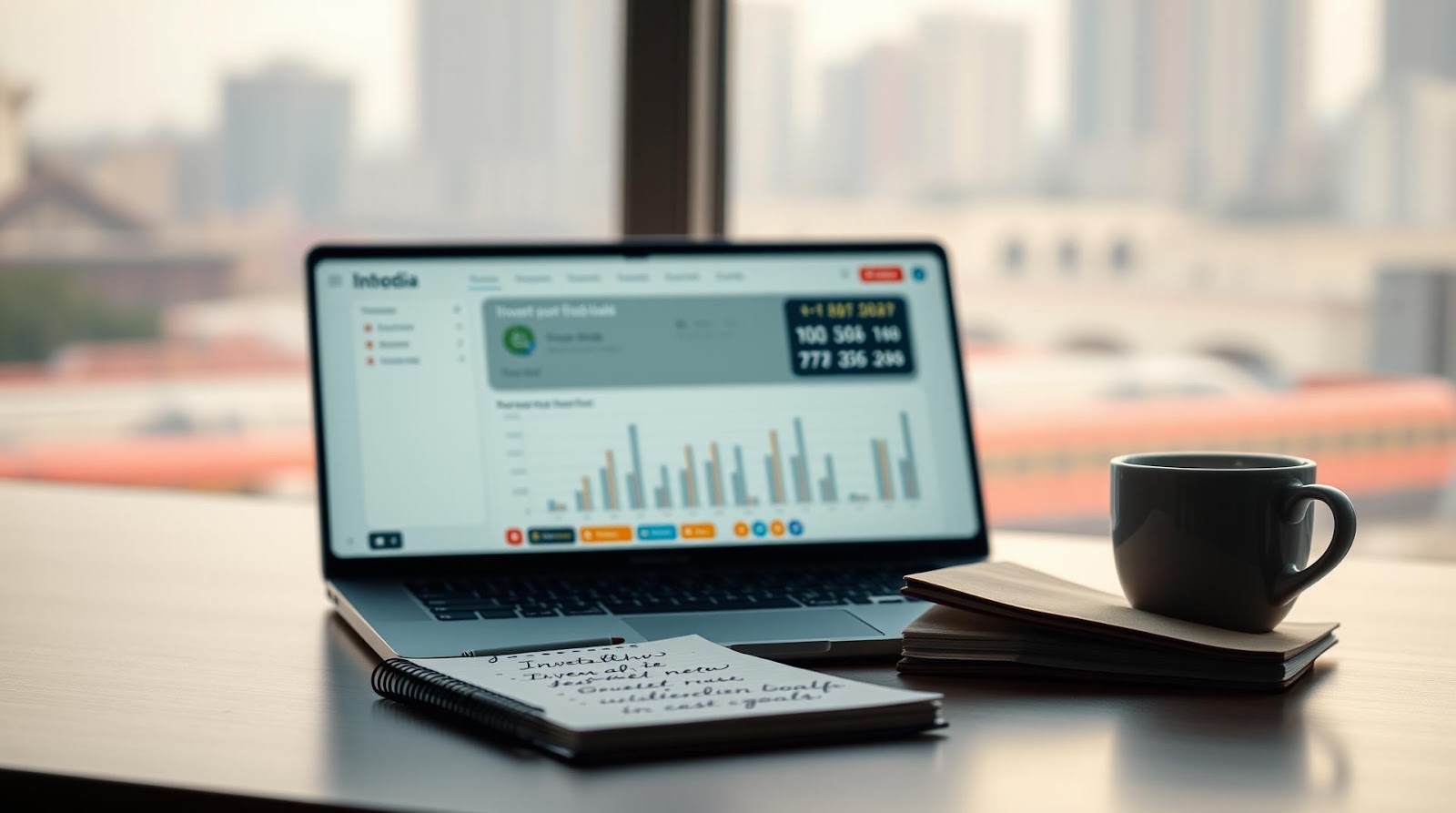
In a single Tuesday morning—just the commute from Kalyan to Bandra—I saw 47 notifications about market moves, RBI decisions, stock splits, and crypto crashes. Forty-seven. My phone buzzed so much I thought it was vibrating on its own. By the time I reached the Morningstar office, I'd already spiraled through three different news apps, two YouTube channels, and a WhatsApp group where someone's uncle was confidently predicting a market correction (he's been predicting it since 2019).
I was overwhelmed. And I work in finance.
If you're an Indian millennial trying to get serious about money—whether that's building an investment portfolio, understanding inflation, or just not feeling stupid during conversations about the stock market—you've probably felt this too. The noise is relentless. Sensationalism is the default. Everyone's selling urgency. And somewhere in that chaos, there are actually useful insights buried under mountains of garbage.
Here's what I've learned after three years of working as a data analyst, deliberately shrinking my news diet, and rebuilding it with actual intention: staying updated doesn't mean staying plugged in 24/7. It means being selective, systematic, and brutally honest about what actually moves your needle.
1. Stop Treating All Finance News as Equally Important
This is where most people fail.
They assume that if something is about money—whether it's the 47th analysis of the Sensex hitting a new high or a 0.25% RBI rate cut or some Bangalore startup raising Series D funding—it all matters equally. It doesn't. And this is the insight that changed how I consume news.
When I look at financial data at work, we categorize information into three buckets: signal, noise, and signal pretending to be noise (that last one's the trickiest). You need to do the same with your personal finance news consumption.
Tier 1: Changes That Actually Affect Your Life
RBI interest rate decisions. Tax policy changes. Inflation shifts (especially food and fuel—things that hit your ₹50,000 monthly budget directly). Stock market crashes of 10%+ (because they reset valuations). New investment rules from SEBI. These move actual money in your life. When the RBI cuts rates, your home loan EMI might drop. When inflation hits 7%, your purchasing power shrinks. These are real.
I check for these maybe twice a week. I've set up Google News alerts for "RBI", "tax changes India", "inflation", and "SEBI new rules". Simple. Focused. Saves me hours.
Tier 2: Context That Helps You Decide
Sector trends (is pharma undervalued?), company earnings (if you own the stock), economic reports (GDP growth, unemployment), and global events that ripple into India (US Fed decisions, crude oil prices). These give you context for bigger decisions—whether to stay invested, rebalance, or increase your SIP amount. They're not urgent. They're strategic.
I spend maybe 1-2 hours a week here. Groww's market updates and the ETMarkets app cover 90% of what I need.
Tier 3: The Noise That Feels Urgent But Isn't
Stock X jumped 15% today (probably coming back down). Crypto had another Twitter meltdown. Some analyst upgraded a stock (others downgraded it). A celebrity endorsed a fintech app. Your friend's uncle made 3x in options trading (and lost 2x before that, but we don't talk about that).
This stuff feels important because it's designed to feel important. It's not. It's noise dressed up as news. I avoid it almost entirely now. And honestly? My investment returns haven't suffered. They've probably improved because I'm not making reactive decisions.
2. Choose Your Sources Like You're Choosing a Bank
There are maybe 200 financial news sources in India. Most of them are fighting for your attention with sensationalism.
You don't need 200. You need 3-5. Maybe 6 if you're really serious.
Here's what I use, and why each one earned its place:
Moneycontrol or ETMarkets for baseline news: They're not perfect (they sometimes hype minor moves), but they separate signal from noise better than most. I check these once daily—usually during lunch at the office.
Mint for Indian economic context: Their personal finance and economics reporting is thoughtful. They explain the "why" behind policy decisions, not just the "what". Takes 10 minutes, happens 3x a week.
Your bank's or brokerage's newsletters: This surprises people, but my HDFC Bank weekly update and Zerodha's Varsity blog actually teach me things. They're curated by professionals. No clickbait (because they don't need clicks—you're already their customer). Spend maybe 15 minutes a week here.
One good YouTube channel (optional): I watch Akshat Shrivastava's occasional deep dives on stock analysis. Not daily. Maybe once a month. But when I do, it's thorough, honest, and he actually admits when he's wrong.
Avoid the rest: News apps with 50 notifications a day. WhatsApp groups where trading "tips" are shared like recipes. Instagram financial influencers. CNBC-TV18 (I used to watch this; it's 60% opinion, 40% yelling). Reddit's r/IndianStockMarket (entertaining, mostly wrong, occasionally brilliant).
And honestly? I don't read international financial news unless it directly affects INR or crude oil. I'm building wealth in India, in rupees. My focus is here.
3. Set a Time Budget, Not an Information Budget
This was the game-changer for me.
I used to think: "I should know as much as possible about markets." So I'd check news constantly. Whenever I had 5 minutes—waiting for the 7:42 AC local, standing in line at the coffee shop, even during meetings (yes, I was that person).
The problem? More information doesn't make better decisions. After a certain point, it just makes you anxious.
So I set a time budget instead. 90 minutes a week. That's it.
Here's how I split it:
- Monday morning (20 mins): Check if anything major happened over the weekend. RBI announcement? Stock market crash? Tax rule change? File it away.
- Wednesday lunch (30 mins): Read the week's economic data. GDP report? Inflation numbers? Interest rate expectations? This shapes my medium-term view.
- Friday evening (20 mins): Weekly portfolio review. Are my holdings making sense? Has anything fundamentally changed?
- Sunday morning (20 mins): One deep dive on a topic I'm curious about. Maybe a new investment category (bonds, for example) or a sector I'm considering.
That's 90 minutes. I'm disciplined about it. When the time's up, I close the apps. And you know what? I feel better informed AND less anxious than when I was checking news constantly.
| Approach | Time/Week | Anxiety Level | Decision Quality |
|---|---|---|---|
| Constant checking (old me) | 3-4 hours | High | Reactive, poor |
| Scheduled slots (new me) | 90 minutes | Low | Thoughtful, better |
| Complete news blackout | 0 minutes | Very low | Blind, risky |
4. Build a Personal "Investment Thesis" (And Stick to It)
Here's something I've learned working with data: people who know what they're looking for find better signal in the noise.
If you don't have a clear investment plan, every piece of news is a threat or an opportunity. The market goes up? FOMO. The market goes down? Panic. Some stock you've never heard of rises 50%? Regret. This is exhausting. And it leads to bad decisions.
But if you have a thesis—a clear framework for what you're trying to build—the noise becomes manageable. You can filter it.
Here's mine: "Build wealth through diversified index funds and a few high-quality individual stocks. Rebalance annually. Increase SIP when salary increases. Stay invested for 20+ years."
This thesis tells me what news matters:
- Index composition changes? Yes, I check.
- Nifty 50 up or down 2%? No, I ignore.
- One of my stock holdings facing regulatory trouble? Yes, I investigate.
- Some startup's IPO pricing? No, probably not for me.
- RBI raising rates? Yes, I factor this into future inflation expectations.
- Gold prices moving? Only if I'm considering adding gold to my portfolio.
The thesis acts like a filter. Without it, everything feels urgent. With it, only relevant news gets your attention.
What should your thesis be? That depends on your goals, risk tolerance, and timeline. But you need one. Spend an hour writing it down. Make it specific to you—not some generic advice from YouTube.
5. Create Friction Between You and the Noise
If you want to check finance news less, make it harder to check.
This sounds silly, but it works. I've done this:
Delete news apps from your phone. Yes, really. I use a browser on desktop for news. That 10-second friction means I actually think about whether I want to check before I do. On my phone, I have only one app: Moneycontrol, and that only because my brokerage links to it.
Turn off notifications. All of them. I don't need a ping telling me Sensex moved 50 points. I check when I want to, not when notifications want me to.
Unsubscribe from most newsletters. I was subscribed to 12 financial newsletters. 11 of them were noise with occasional signal. I kept one (Mint Money). Saved me 20 minutes a week and dropped my anxiety noticeably.
Leave the WhatsApp groups. Or mute them with settings so you see messages once a week, not in real-time. Your neighbor's cousin's theory about upcoming market crashes doesn't deserve live notifications.
Schedule news time, not impulse time. I check news at specific times. Not whenever I think about it. This prevents the "let me just quickly check" that turns into 30 minutes of scrolling.
My Perspective
Working at Morningstar taught me something that shocked me: professional analysts who have access to everything—every data source, every research report, every market feed—still make better decisions when they're selective. We have one analyst who only reads quarterly earnings reports and the RBI's policy documents. He consistently outperforms colleagues who read everything. Why? Because he knows what moves markets. He filters ruthlessly.
I also realized something personal: I used to pride myself on being "up-to-date." If someone mentioned a market event and I hadn't heard, I felt dumb. So I over-consumed news to avoid that feeling. That's a terrible reason to do anything. Turns out, you can be financially smart, make good decisions, and not know about 90% of financial news. It's liberating.
The thing that surprised me most? After cutting my news consumption by 80%, my portfolio returns didn't drop. They stayed the same or improved. Because I was making fewer reactive decisions. Less is actually more here.
Final Thoughts
You don't need to know everything happening in finance to build real wealth. You need to know enough to make decisions aligned with your goals, and then you need to stick to those decisions without second-guessing them every time a stock moves or an analyst changes their rating.
The daily commute from Kalyan to Mumbai taught me patience—you're stuck in traffic regardless of how anxious you are, so you might as well accept it. The same applies to markets. They'll do what they do. Your job is to have a plan and execute it calmly, with selective information input, not constant noise.
Start with what I've shared here. Pick 3-5 sources. Set a 90-minute weekly budget. Write down your investment thesis. Create friction between you and the noise. Give it a month. I think you'll be surprised—not by how much you're missing, but by how much clearer your thinking becomes.
And if you ever need reassurance? Remember that every billionaire investor got there by filtering noise, not by consuming it. You're in good company.
Dattatray Dagale
Data Analyst • Blogger • Mumbai
I'm a data analyst from Kalyan, Maharashtra, working at Morningstar. I write about personal finance, career growth, and everyday life for Indian millennials — the stuff I wish someone had told me earlier.
Written by Dattatray Dagale • 23 May 2026





.png)

.gif)


0 Comments