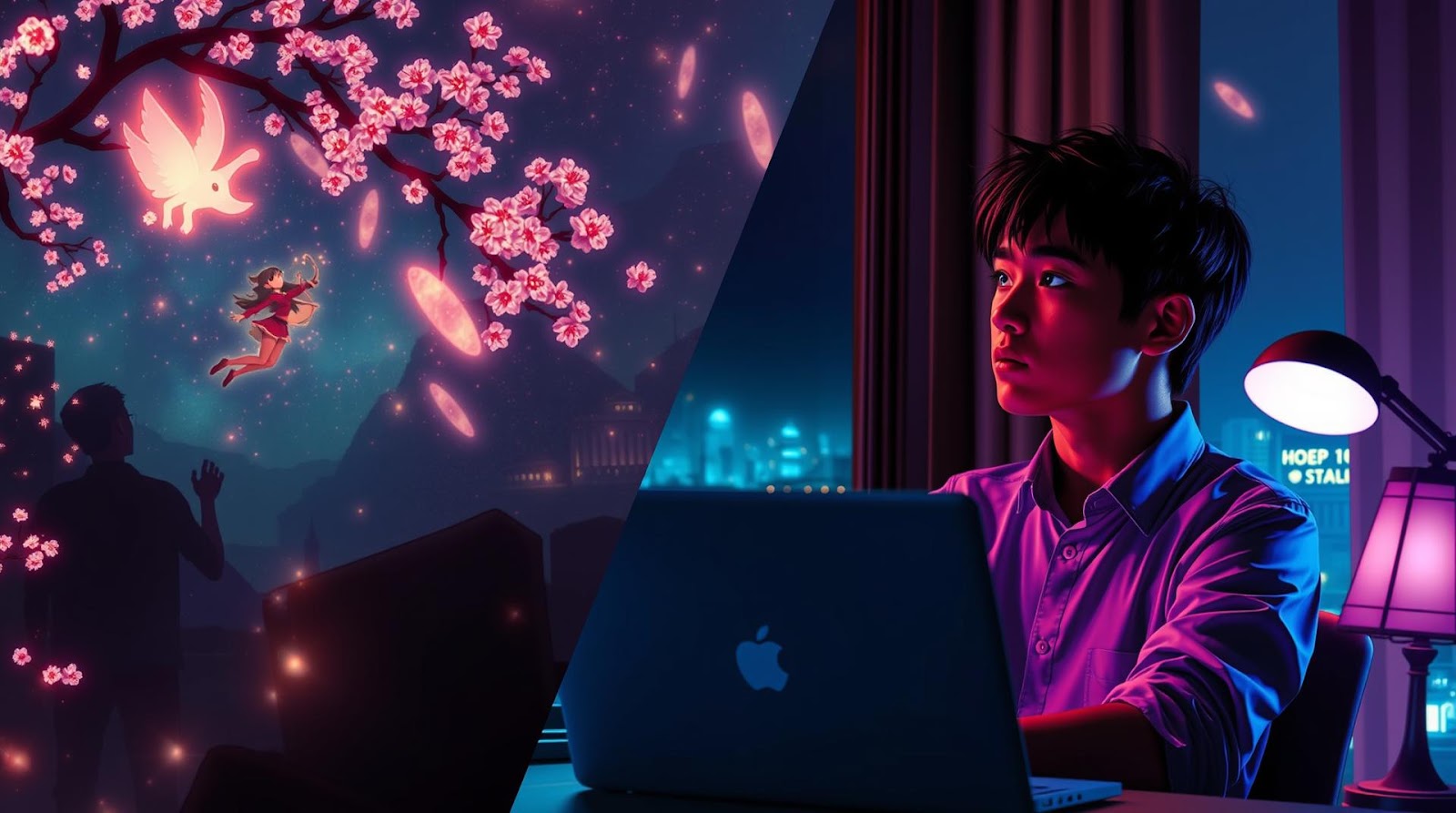
Last year, I was stuck. Not the kind of stuck where your laptop freezes—the kind where you're sitting in your apartment, scrolling through Instagram at 11 PM, feeling like everyone's figured out something you haven't.
A friend texted me: "Watch Steins;Gate." Not exactly what I was looking for when I was googling "how to find purpose," but I was desperate enough to try anything.
Three weeks later, I'd watched twelve anime series. And here's the wild part: I wasn't escaping reality anymore. I was seeing it differently.
I know what you're thinking. Anime? Seriously? The thing with big eyes and screaming characters? Yeah, that's exactly what I thought too. But here's the thing about assumptions—they're usually wrong. And that's kind of what this whole journey has been about.
Let me tell you why I think you should give this a chance, especially if you're someone navigating your 20s or 30s in India right now. Because honestly, the philosophical depth in some of these shows rivals anything you'll find in a self-help book. And unlike most self-help books, they're actually engaging.
The Ones That Actually Hit Different
Not all anime is created equal. Most of it is... fine. Entertaining. But the ones I'm about to tell you about? They're the ones that will sit with you for weeks. The ones where you'll be doing something completely mundane—like calculating your SIP contributions on Zerodha—and suddenly a scene will pop into your head and you'll think, "Oh. That's what they meant."
Steins;Gate — Time, Choices, and Butterfly Effects
This is the one that started it all for me. The premise is simple on the surface: a group of college kids accidentally invent a time machine via microwave. But it's really about something else entirely.
It's about how small decisions ripple outward. How trying to "fix" the past creates chaos in the present. How sometimes the best version of life isn't the one where everything goes right—it's the one where you accept what you can't change and move forward anyway.
And honestly? As someone who's spent way too much time second-guessing career decisions and wondering what would've happened if I'd taken that job in Bangalore instead of staying in Mumbai, this hit me hard. The show doesn't give you false comfort. It doesn't say "everything will work out." It says something scarier and more real: "Your responsibility is how you move forward from here, not rewriting where you came from."
There's a scene about halfway through where the main character realizes he can't save everyone. It's not a dramatic, climactic moment. It's quiet. And it destroyed me in the best way.
Attack on Titan — Freedom, Systems, and Illusion
I was hesitant about this one. It looked too action-heavy, too mainstream. But the deeper you go, the more it becomes a meditation on freedom itself.
Without spoiling anything: the show asks a question that gets more uncomfortable as it goes. "What if the system you believe is protecting you is actually the cage?" It's political. It's philosophical. And it hits especially hard for anyone who's ever felt trapped by societal expectations or family pressure.
There's a specific moment in Season 3 where a character realizes they've been taught to hate an entire group of people without ever questioning why. And they have to sit with that discomfort. They have to actually examine their beliefs instead of just inheriting them.
For us—millennials and Gen-Z professionals in India—this is relevant. How many of our beliefs about success, money, relationships, and life choices are genuinely ours? How many are inherited assumptions that we've never actually questioned?
Natsume's Book of Friends — Loneliness, Belonging, and Small Kindnesses
This one's gentler. Quieter. It's about a boy who can see spirits that no one else can, and how he slowly learns that being different doesn't mean being alone.
What surprised me was how much it taught me about loneliness. Not the dramatic kind. The everyday kind. The kind where you're surrounded by people but still feel invisible. The kind where you're convinced nobody wants you around.
The show doesn't solve this with a grand gesture. It solves it with consistency. With small acts of showing up. With understanding that sometimes the most profound gift you can give someone is simply not abandoning them.
I watched this during a period where I'd just switched jobs and felt like I'd lost my entire social circle. Seeing Natsume slowly build genuine connections—not through being perfect, but through being present—changed how I thought about friendship.
Why Anime, Specifically?
You could get these lessons from books, therapy, or a long conversation with a wise friend over chai. So why anime?
Here's my honest take: anime has a unique advantage. It's visual. It's emotional. And it doesn't feel preachy because the creators aren't trying to teach you a lesson—they're telling a story, and the philosophy emerges naturally.
When you read a self-help book that says "small actions compound over time," your brain files it away as information. When you watch a character over 24 episodes slowly transform their life through tiny, consistent choices, your brain doesn't just understand it. It feels it.
Also, anime has less cultural baggage for us. A life lesson wrapped in Japanese animation doesn't carry the same "this is what you should do" weight that it would from your parents, your boss, or your Instagram feed. You're more open to it. You're more willing to sit with the discomfort.
Other Shows Worth Your Time
Beyond the Big Three
Demon Slayer looks like pure action, but it's really about grief, purpose, and whether you can stay human when the world is trying to make you a weapon.
Jujutsu Kaisen explores ambition and the cost of power. And honestly? The conversations about what it means to be "strong" are more nuanced than most MBA programs I've encountered.
A Place Further Than the Universe is about four girls going to Antarctica and discovering that the destination doesn't matter as much as who you're traveling with and what you learn about yourself along the way. It's wholesome, funny, and surprisingly deep.
Mob Psycho 100 is about a boy with psychic powers learning that having power doesn't actually solve anything. It's funny, heartwarming, and has probably the most realistic portrayal of anxiety and social awkwardness I've seen in any medium.
| Anime | Core Theme | Best For | Episode Length |
|---|---|---|---|
| Steins;Gate | Time, regret, acceptance | Career doubters, overthinkers | 24 episodes |
| Attack on Titan | Freedom, societal control | Question-askers, rebels | 49 episodes |
| Natsume's Book of Friends | Belonging, kindness | Lonely souls, people-pleasers | 76 episodes |
| Mob Psycho 100 | Power, normalcy, growth | Socially anxious, ambitious people | 25 episodes |
How to Actually Start (Without Falling Into a Rabbit Hole)
Okay, real talk. Anime can become addictive. Last month I spent an entire weekend watching 15 episodes of something when I was supposed to be finishing a freelance project. CRED notifications were piling up about my bill payments and I was just... lost in a story.
So here's how I've made it work:
Pick one. Don't start five shows at once. Choose one from the list above based on what's bothering you right now. Struggling with direction? Steins;Gate. Feeling trapped? Attack on Titan. Lonely? Natsume.
Set a boundary. I give myself one episode per day maximum on weekdays. It's enough to stay engaged without derailing my actual life. On weekends, I'm a bit more flexible, but even then I try not to binge more than 3-4 episodes.
Actually think about it. Don't just watch passively. After each episode, take 5 minutes. What did that scene mean? Why did that character react that way? How does this connect to something in your life? This is where the real value is.
Write about it. Seriously. I started writing down thoughts about episodes I watched, and it helped me internalize the lessons way better. You don't need to be eloquent. Just genuine.
Final Thoughts
Here's what I've learned: wisdom doesn't care about packaging. It can come from a 200-page philosophy book or a 24-minute animated episode. What matters is whether it makes you think differently.
And honestly? These shows did that for me. They made me kinder. More patient with uncertainty. Better at accepting things I can't change while still fighting for the things I can.
I'm not saying anime is a replacement for therapy, or reading, or actual human connection. It's not. But it's a tool. And sometimes we need tools to help us see what we've been missing.
So if you're stuck like I was—scrolling through your life without really living it—maybe give one of these a shot. Not because I'm telling you to. But because you're curious. Because you're wondering if there's something more. Because you deserve to understand your own life better.
Start tonight. One episode. See what happens.
Written by Dattatray Dagale • 22 May 2026


.png)
.png)


0 Comments