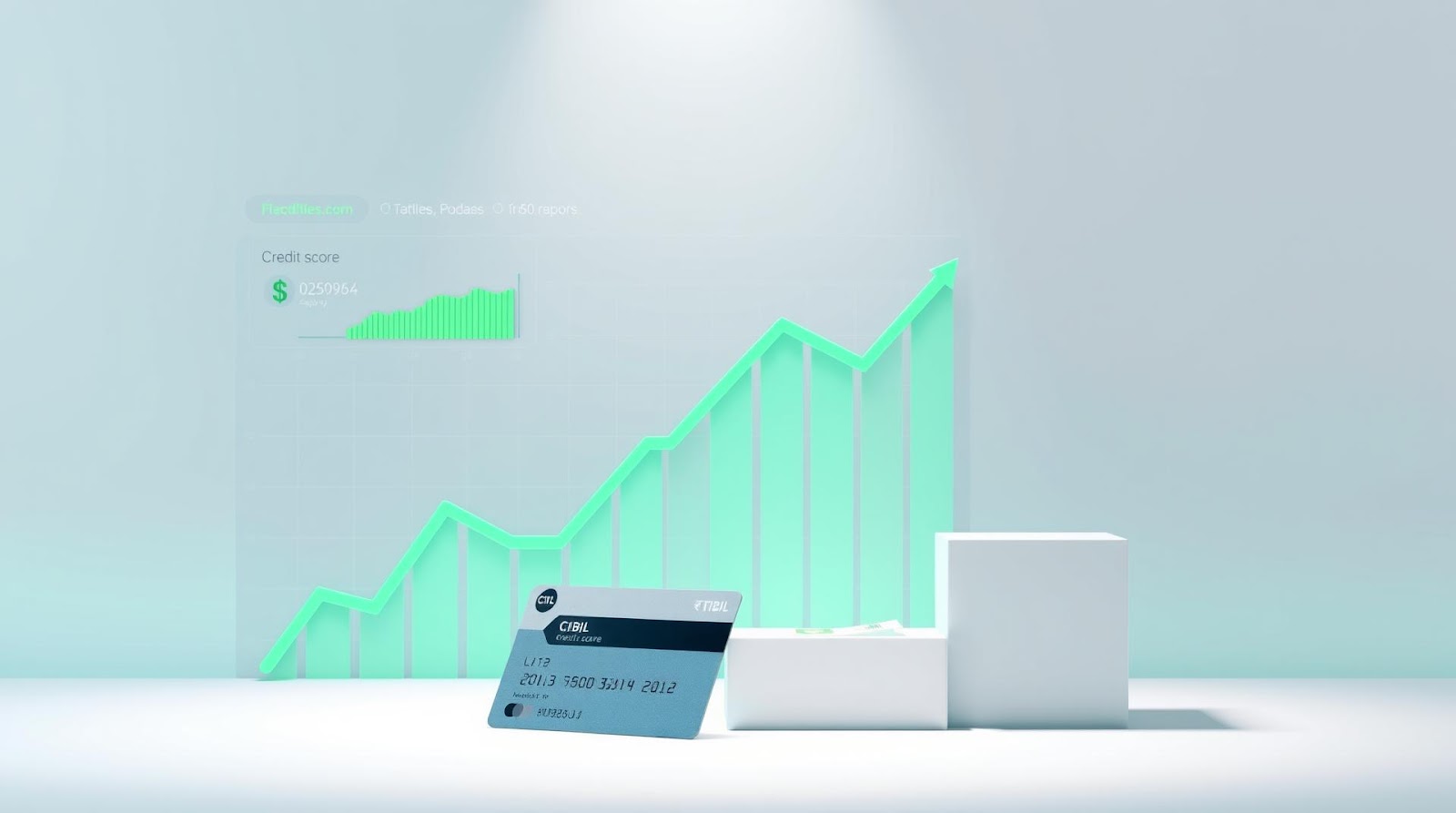
Three years ago, I didn't check my credit score. Not once. Not because I was irresponsible—I paid my bills on time, I thought I was fine. But "fine" and "actually fine" are two very different things in India's financial system, and I learned that lesson the hard way when I applied for a home loan.
The bank rejected me. Not because I couldn't afford it. Not because my salary was too low. My credit score was 712—which sounds okay until you realize most lenders want 750+. I sat across from the loan officer, genuinely confused. How could someone who never missed a payment be denied?
That's when I realized: I'd been confidently wrong about credit scores for years.
Most of us think credit scores are simple. Pay your bills, get a good score. Move on. But here's the thing—there's a massive gap between paying on time and actually building a strong credit profile. And that gap? It costs you money. Real money. In higher interest rates, rejected applications, and missed opportunities.
So I spent the last three years learning what actually moves the needle on a credit score in India. This is what I got wrong first, and what I actually learned.
Myth 1: Paying Your Bill on Time Is Enough
This is the myth I lived by. Every month, my phone bill was paid. My credit card statement? Cleared in full. My EMI for my two-wheeler? Never late. I genuinely believed this was sufficient.
What I didn't understand: credit bureaus don't just track whether you paid. They track how much you paid, when you paid it, and how much credit you're using.
The Credit Utilization Trap
Here's what actually happened in my case. I had a credit card with a 2 lakh rupee limit. Every month, I'd spend around 1.8 lakh and then pay it all off by the due date. Full payment, no interest. Sounds perfect, right?
Wrong. I was using 90% of my available credit every single month. The credit bureau saw this as risky behavior—like I was constantly maxing out my card. It didn't matter that I paid in full. The algorithm flagged me as potentially overextended.
The fix was counterintuitive: I got my limit increased to 4 lakh rupees. Now, spending the same 1.8 lakh meant I was using only 45% of my credit. Within 6 months, my score jumped 28 points.
Most people don't know this because banks don't advertise it loudly. They benefit more from you not optimizing. But here's the reality—credit utilization makes up 30% of your CIBIL score in India. Paying on time is only 35%. Do the math: if you're getting only 35% right and ignoring 30%, you're leaving serious points on the table.
Why the Payment Date Matters More Than You Think
I also used to pay my credit card bills on the due date—the last possible day. Safe, right? The payment cleared, so I thought I was good.
But here's what I didn't know: credit card statements are generated on a fixed date every month. Let's say your statement date is the 5th and your due date is the 20th. The amount you've spent by the 5th is what shows up on your credit report. If you spend 50,000 rupees on the 10th and pay it on the 20th, the bureau still sees 50,000 in outstanding credit on your statement date.
Now shift that—pay before the statement date. Suddenly, that 50,000 rupee transaction never appears as outstanding credit on your report.
I started paying my credit card bill around the 2nd of every month, right after getting my salary. My utilization ratio dropped without changing my spending habits at all. This is the kind of thing nobody talks about, but it's pure optimization.
Myth 2: You Don't Need Multiple Types of Credit
For the longest time, I thought credit was credit. A credit card is credit, an EMI is credit—what's the difference? They all go on the same report, so they should count the same way, right?
Nope. This was another blind spot that cost me.
Secured vs. Unsecured Credit
Credit bureaus care deeply about what kind of credit you've managed. There are two main buckets: secured credit (backed by collateral—like a home loan or auto loan) and unsecured credit (like credit cards or personal loans).
When I applied for that home loan with a 712 score, the bank's system flagged something: I had mostly unsecured credit. A credit card, a personal loan I'd taken for a laptop, that's it. No car loan, no home loan history, nothing showing I could manage a large amount of borrowed money over years.
The irony? I had the money to buy a car outright. But from a credit bureau's perspective, that made me less creditworthy, not more. Because I'd never proven I could manage a large, long-term debt responsibly.
This is when I realized: building credit isn't just about not defaulting. It's about building a portfolio that demonstrates financial responsibility across different credit types.
The Power of a Second Credit Card
After my loan rejection, I applied for a second credit card. My first instinct was to keep it for emergencies only. But my relationship manager at HDFC Bank explained something: even if I never use the second card, it increases my total available credit and diversifies my credit mix.
A diversified credit profile—credit cards, an EMI, maybe a small loan—shows lenders you can handle different types of credit simultaneously. It's one of those things that sounds obvious once you know it, but nobody explains it upfront.
Within 8 months of getting that second card and using it lightly (keeping utilization under 10%), my score jumped from 712 to 748. Still not 750, but getting close. The combination of optimized payment timing, lower utilization on my first card, and a new diverse account mix was working.
Myth 3: Your Credit Report Is Always Accurate
Here's something I assumed and never verified: the credit bureau has my correct information. Wrong again.
When I finally started checking my CIBIL report (I know, I should have done it years earlier), I found errors. Small ones, but errors nonetheless. A credit card with a balance that had already been paid off still showed as outstanding. An old mobile postpaid bill from 2016—which I'd settled—still appeared as a default.
These errors weren't killing my score dramatically, but they were dragging it down. And I had no idea.
How to Get Your Report and Fix Errors
Getting your CIBIL report is free. Go to www.cibil.com, enter your details, and it takes 15 minutes. Download it. Read it carefully.
Look for three things: First, are all the accounts listed actually yours? Second, do the statuses match what you know to be true? Third, are there any defaults or late payments you dispute?
If you find errors, file a dispute. CIBIL has a formal process. You submit a written complaint (email works), they investigate with the lender, and if the lender confirms the error, it gets removed. This can take 30–45 days, but it's worth it.
I disputed three items. Two were removed entirely (the settled mobile bill and one credit card). One remained because—honestly—I had actually missed a payment in 2015 and the lender confirmed it. But at least I knew the real situation instead of guessing.
After the corrections were made, my score jumped another 12 points to 760. Now we're talking.
Myth 4: Once Your Score Is Good, You Can Stop Thinking About It
I hit 760 and celebrated. I thought I'd done it. Credit problem solved.
Then I didn't touch my finances for four months. No new applications, no monitoring, just life. When I checked again after applying for a home loan a second time, my score had dropped to 742.
Why? The banks saw inactivity on my accounts. My credit card had a zero balance (because I pay it off every month), which looked like inactivity to the algorithm. My second credit card had never been used. The system interpreted this as me not maintaining active credit.
That's when I realized: credit scores aren't like a grade you get once and keep forever. They're dynamic. They change every month based on your current behavior.
The Maintenance Game
Building a credit score is 30% effort. Maintaining it is 70% consistency.
Now I keep my credit cards active with small transactions—a monthly Spotify subscription on one, gym fees on another. Nothing big, but enough to show activity. I pay them off before the statement date. I check my CIBIL report quarterly (not monthly—quarterly is enough). I don't apply for new credit unless I genuinely need it (each new application creates a hard inquiry and dips your score temporarily).
This maintenance routine takes maybe 30 minutes a month. It's not glamorous, but it works. My score now sits at 765–770, consistently.
What Actually Moves Your Score
Let me break down exactly what matters in your CIBIL score—the actual weightage:
| Factor | Weightage | What It Means |
|---|---|---|
| Payment History | 35% | On-time payments on all credit accounts |
| Credit Utilization | 30% | How much of your available credit you use (aim for <30%) |
| Credit Mix | 15% | Variety of credit types (cards, loans, EMIs) |
| Credit Age | 10% | How long you've been using credit (older is better) |
| Hard Inquiries | 10% | Recent credit applications (fewer is better) |
This is the actual breakdown. Most people focus only on the first one—payment history. But if that's all you optimize, you're leaving 65% of the score on the table.
The Practical Action Plan
Month 1: Get your free CIBIL report and fix any errors. Check www.cibil.com.
Month 2–3: Request a credit limit increase on your existing card (if you have good payment history). This instantly lowers your utilization ratio.
Month 4: If your score is still below 700, apply for a second credit card with a lower limit. Keep utilization under 20%.
Ongoing: Set a phone reminder to pay credit card bills 5 days before the statement date. Don't miss a single payment. Check CIBIL quarterly.
Follow this, and you'll see movement. Not overnight—credit bureaus work on month-long cycles—but within 3–6 months, you should see a 40–50 point jump if you're starting from 650–700.
My Perspective
Here's what surprised me the most: my first home loan rejection wasn't because I was financially irresponsible. I had savings, I had a stable job at Morningstar, my salary was decent for Mumbai. The rejection was purely because I hadn't played the credit game correctly.
That stung. Because it felt like the system was penalizing me for not knowing the rules, not for actually being risky.
But once I understood the rules, I realized something else: they made sense. Lenders want to see that you can manage different types of credit responsibly, that you don't overextend yourself, that you're consistent. These are fair measures of financial health.
The mistake wasn't the system. It was me assuming credit was simple and ignoring the details. When I finally applied for that home loan the second time with a 765 score, it was approved in 10 days at a rate 0.3% lower than what was quoted the first time around. That 0.3% difference on a 50 lakh loan across 20 years? That's almost 3 lakh rupees I was going to save. All because I spent three months optimizing something I initially thought was "good enough."
That's the math nobody talks about. Your credit score directly translates to money in your pocket or out of it.
Final Thoughts
If you're reading this and thinking, "Why does this matter so much?"—it matters because financial systems in India are increasingly credit-driven. You can't just ignore this and hope for the best. A good credit score doesn't just help with loans. It affects insurance premiums, credit card approvals, even salary negotiations with some employers who check financial health.
The good news? You're not at the mercy of some mysterious algorithm. The factors that build a credit score are transparent and within your control. It takes discipline, not luck. It takes consistency, not complexity.
Start today. Get that CIBIL report. Spend 30 minutes understanding where you stand. Then pick one action—lower your utilization, fix an error, or optimize your payment date. Don't try to fix everything at once. One step at a time.
Your future self—the one applying for a home, or a car, or anything that requires credit—will thank you. Trust me on this one.
Dattatray Dagale
Data Analyst • Blogger • Mumbai
I'm a data analyst from Kalyan, Maharashtra, working at Morningstar. I write about personal finance, career growth, and everyday life for Indian millennials — the stuff I wish someone had told me earlier.
Written by Dattatray Dagale • 31 May 2026



.png)
.gif)



0 Comments