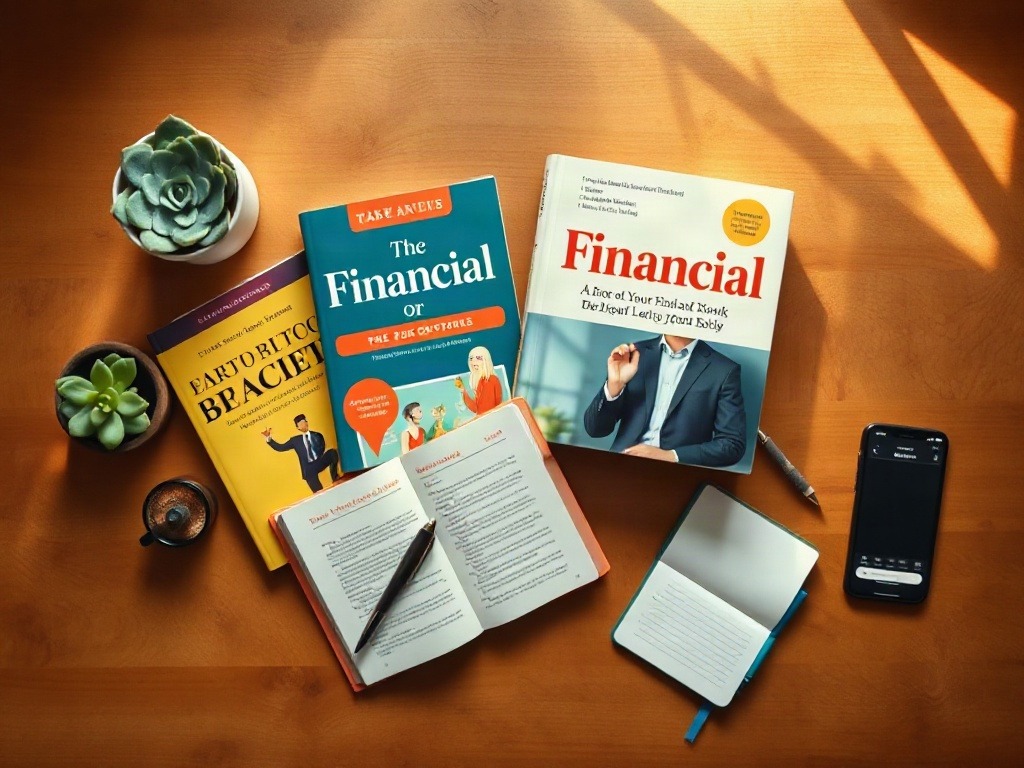
I used to think that reading books on money was like going to the gym — the more you do it, the better you become.
So between 2019 and 2021, I read everything. Rich Dad Poor Dad. The Intelligent Investor. A Random Walk Down Wall Street. Atomic Habits (because apparently habits matter for money too). I'd finish one book and immediately start the next, thinking each new title would unlock some secret formula that would suddenly make me rich.
Here's what actually happened: I stayed broke.
Not because I wasn't reading. But because I was reading everything without applying anything. I'd absorb one book's philosophy on diversification, then the next book's contrarian take on index funds, and by the time I finished, my head was spinning and my portfolio was... non-existent. I was collecting knowledge like it was Pokemon cards.
The turning point came during my daily Mumbai-to-Kalyan commute (yes, I do it backwards — I live in Kalyan, work in Mumbai). I was reading yet another book on wealth-building when my Groww app notification popped up showing my ₹500 monthly SIP had been running untouched for 18 months. I realized something: I didn't need more books. I needed the right books, read at the right time, actually implemented.
If you're in your twenties or early thirties and you're thinking about money seriously for the first time, you don't need a library. You need four books — in this order. And more importantly, you need to actually do something after you finish each one.
What I Got Wrong About Money Books
Before I recommend anything, let me tell you what I discovered about myself as a reader:
I thought more books = more knowledge
This is the biggest trap. I genuinely believed that if I just read five books on personal finance, I'd somehow absorb the "system" and automatically become financially literate. What actually happens is you get decision paralysis. You read about value investing in one book, passive index investing in another, and you end up doing nothing because every strategy seems to contradict the previous one.
The real skill isn't reading 20 books. It's reading one book, understanding it deeply enough to disagree with parts of it, and then building your own philosophy from there.
I ignored books written for Indians, specifically
I spent two years reading about S&P 500 and Roth IRAs. Very useful for Americans. Completely irrelevant for someone earning in rupees, paying Indian taxes, and trying to build wealth within the Indian market. I was basically learning how to drive on the wrong side of the road.
And honestly? The best finance books I've read in the last two years were written by Indians or specifically address the Indian context. They didn't feel like they were translated from another culture's problems.
I skipped the "boring" foundational books
I wanted to jump straight to "how to become a millionaire" books. What I needed was to understand compounding, tax, inflation, and risk first. It's like wanting to understand options trading before you've opened a Zerodha account.
The Four Books You Actually Need (In Order)
Book 1: I Will Teach You to Be Rich by Ramit Sethi (Yes, Again. But Hear Me Out.)
I know. You've heard about this book a thousand times. Everyone recommends it. But here's why it deserves to be your first book, not your fifth:
This book doesn't assume you know anything. It walks you through opening a bank account, setting up automated transfers, understanding tax-advantaged accounts, and building a basic investment portfolio. For someone in their twenties who's never had a proper financial conversation, this is the foundation you need.
Yes, Sethi is American, so some sections won't apply. But the psychological framework — why you spend money, why you avoid talking about money, how to automate your finances so you stop thinking about it — that part is universal. And honestly? There's enough India-relevant content sprinkled throughout that the book feels more culturally aware than most Western finance books.
What you'll do after reading this: Set up an emergency fund (₹50,000-₹1 lakh depending on your lifestyle), automate a monthly investment, and stop feeling guilty about money.
Book 2: The Intelligent Investor by Benjamin Graham (The Specific Indian Edition)
Here's the thing about The Intelligent Investor — the original text is long, dense, and assumes you're buying individual stocks in 1950s America. You don't need to read that version.
Read the Indian edition or find the annotated version that contextualizes Graham's principles for modern markets. The core concept — invest in undervalued assets, understand what you're buying, and hold for the long term — is timeless. But you need to understand how this applies to Indian stocks, mutual funds, and ETFs.
I used to skip this book because I thought I wasn't "ready" for real investing. Then I realized Graham's whole message is you're probably not, and that's okay — just buy good companies and wait. It's the anti-FOMO book. In a market where everyone's trading F&O (futures and options) on Zerodha like it's a game, Graham's voice saying "just buy index funds and chill" feels radical and honest.
What you'll do after reading this: Understand the difference between the price of a stock and its value, stop checking your portfolio every day, and commit to a 10+ year investment horizon.
Book 3: Money: Master the Game by Tony Robbins (Yes, It's Motivational. That's The Point.)
After Sethi's practical basics and Graham's investing philosophy, you need something that connects money to your actual life and goals.
Robbins' book is part psychology, part investment strategy. The Indian context matters less here because the book is about understanding your relationship with money — why you're afraid of it, why you avoid thinking about it, how money ties into your identity and self-worth. There's a section on financial goals that's actually useful: he breaks down saving strategies based on different time horizons and risk profiles.
Is the book overly long and repetitive? Yes. Could it be a 200-page book instead of 600 pages? Absolutely. But sometimes you need that repetition and motivation, especially in month 3 when your first SIP feels pointless because you're only ₹1,500 richer.
What you'll do after reading this: Define what "rich" actually means to you (not what society says it should mean), set real financial goals with timelines, and stop treating money anxiety like something you should ignore.
Book 4: Fooled by Randomness by Nassim Nicholas Taleb (The Reality Check)
By the time you finish book three, there's a danger: you might actually think you understand money and markets now.
Taleb's book is the antidote. It's humbling. It's specifically about how we humans are terrible at understanding probability, how we attribute success to skill when it's often luck, and how markets can do unexpected things regardless of how well-researched you are.
This book feels pessimistic until you realize it's actually liberating. Once you truly understand that you can't predict the market (and neither can anyone else), you stop trying. You stop listening to CNBC talking heads, stop day-trading on your phone during lunch breaks, and stop feeling like an idiot when the market does something random.
I used to read stock tips on Reddit and feel bad that I wasn't that clever. After Taleb, I realized those people aren't clever — they're just getting lucky in a bull market and will probably get destroyed when randomness swings the other way.
What you'll do after reading this: Build a defensive portfolio, stop trying to time the market, and accept that boring index funds might be the best choice precisely because they're boring.
| Book | Main Lesson | Action After Reading | Read This If... |
|---|---|---|---|
| I Will Teach You to Be Rich | Automate everything, build emergency fund, start investing | Open savings account, set up ₹500/month SIP, build ₹50K emergency fund | You've never invested before |
| The Intelligent Investor | Understand value, think long-term, ignore market noise | Research 2-3 stocks/index funds, commit to 10-year hold, stop checking daily prices | You want to understand *why* you're investing |
| Money: Master the Game | Define your goals, connect money to meaning, get motivated | Write down 3 financial goals with timelines and amounts, adjust SIP based on goals | You're losing motivation or your goals feel unclear |
| Fooled by Randomness | Accept you can't predict markets, embrace boring strategy | Unfollow stock tip accounts, move to 80/20 index/stock portfolio, stop day-trading | You're overconfident about your investment decisions |
How to Actually Use These Books (Not Just Read Them)
Read sequentially, not simultaneously
I used to have four books going at once. Now I read one, finish it completely, and wait a week before starting the next. That week is when you implement. You set up the emergency fund from book one before you open book two. You read about investment philosophy in book two before you start thinking about your actual goals in book three.
Write down what surprised you
Not a formal review. Just: one sentence per day about what stuck with you. Something concrete. "I didn't know tax-loss harvesting existed" or "I realized I've been thinking about stocks like lottery tickets" or "The concept of mental accounting finally clicked." These one-liners become your personal manifesto on money, way more valuable than the book itself.
Discuss with someone else
I joined a small group of friends where we read one of these books together over two months. We'd meet once and talk about it for an hour. The conversations were better than the books themselves. You catch things you missed, challenge parts you disagreed with, and realize what actually applies to your life versus what doesn't.
My Perspective
Three years ago, I decided to stop reading and start implementing. I took what Sethi taught me and set up a ₹10,000 monthly SIP into a Nifty 50 index fund. That's it. No individual stocks, no options trading, no timing the market. Just ₹10,000 every month into Groww, no drama.
Last month, that portfolio crossed ₹5 lakhs. Not because I'm a genius investor. But because I read the right books in the right order, understood the philosophy behind what I was doing, accepted that I can't predict markets, and then just... did it consistently for three years without touching it.
The surprising part? It was boring. Incredibly boring. I expected this epic financial journey. Instead, I just automated a transfer and forgot about it. That's actually when I knew the books had worked — when I stopped thinking about money and started just living with a plan. The anxiety lifted because I wasn't trying to be clever anymore. I was just following a principle I actually understood and believed in.
Final Thoughts
Here's what I want you to know: you don't need to read every book on money. You don't need to be a finance expert. You don't need to understand derivatives or real estate or cryptocurrency to be financially healthy.
You need to understand four things: how to save without thinking about it, why companies gain value over time, what your actual financial goals are, and why you can't predict when things will go up or down. Read these four books in order, do one thing after each, and you're ahead of 95% of people your age.
And if you're reading this thinking, "I don't have time to read four books" — you do. These aren't textbooks. They're stories. They're written to be read on your daily commute (yes, I'm speaking from experience on the Western Line every morning). The time isn't the barrier. Actually doing something after you finish is.
Start with Sethi this month. I'll be curious what you do after you finish it.
Dattatray Dagale
Data Analyst • Blogger • Mumbai
I'm a data analyst from Kalyan, Maharashtra, working at Morningstar. I write about personal finance, career growth, and everyday life for Indian millennials — the stuff I wish someone had told me earlier.
Written by Dattatray Dagale • 17 September 2026




.png)
.png)


0 Comments