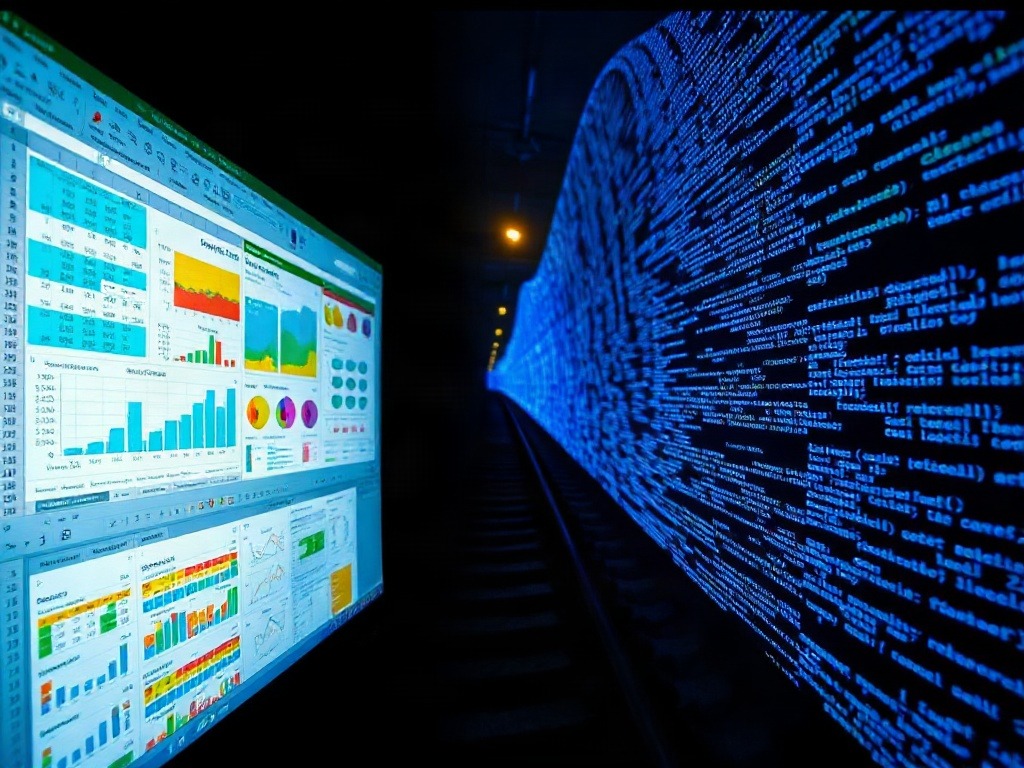
Dear friend,
I'm sitting at my desk in the Morningstar Mumbai office—same desk I've occupied for the last four years—and I keep getting the same question from people back in Kalyan. Usually it's someone's kid, or a cousin who just finished their degree, or someone I ran into at the local chai shop who heard I work with data.
"Bhaiya, should I learn Python or Excel first?"
I used to have a quick answer. Spoiler: I was wrong. Not entirely wrong, but wrong enough that I've changed my mind twice since I started working here. And because you've asked me this same question over chai last month, and because I genuinely wish someone had spelled this out clearly for me when I was sitting where you are now (probably in Kalyan, probably stressed about the commute to Mumbai in the future), I'm writing this as a letter to you.
Not a guide. Not a listicle. A real conversation about two tools that will shape how you think about data for the next decade.
The Question Nobody Asks First
Here's what I notice: everyone asking this question is already making an assumption. They think it's a binary choice. Learn one. Then learn the other. One after the other, like levels in a video game.
That's not how it works.
And honestly? If I'd understood this upfront, I would've saved myself six months of confusion and at least ₹5,000 on online courses I never finished.
The real question isn't "Python or Excel?" It's "What problem am I trying to solve right now, and which tool gets me to an answer fastest?"
I studied Economics at university. One of my professors—Dr. Sharma, the one who always wore the same grey sweater—once said something that stuck: "The best tool is the one that removes friction between your brain and your answer." I didn't fully get it then. I get it now.
Excel removes friction in hours. Python removes friction in weeks. But then Python removes friction for months and years after that.
Why This Matters Right Now
You're probably 23, 24, maybe 26. You might have a job already, or you're about to interview for one. You need to show competence. You need to show impact. You need to do this in the next 6-8 weeks, not 6-8 months.
That changes everything.
Excel First—But With a Caveat
Let me say this clearly: you should learn Excel first.
Not because it's "easier" (though it is). Not because it's more practical (though it is that too). But because Excel is how you think about data problems before you learn to code.
Think about it this way: when you want to understand how Zerodha's Kite app works, you don't start by reading the source code. You start by clicking buttons, watching what changes, understanding the flow. Excel is that button-clicking phase for data analysis.
In my first three months at Morningstar, I built a model to compare mutual fund performance across categories. Took me two weeks in Excel. Would've taken me three weeks in Python (I would've spent the first week just setting up the environment and debugging). The Excel model worked. My manager saw it. My credibility went up. That matters when you're new.
What Excel Actually Teaches You
Excel teaches you logic before syntax. It teaches you to ask: "What calculation do I need? Where's my data? What's my output?" These are the real questions. The tool is secondary.
You learn VLOOKUP and suddenly you understand joins. You learn pivot tables and suddenly you understand aggregation. You learn conditional formatting and suddenly you understand how to spot patterns. These aren't Excel skills. These are data skills. Excel is just the translator.
Plus—and this is important—you'll use Excel your entire career. Even after you're comfortable with Python. Even if you work with massive datasets. Even if you become a data engineer. You'll still use Excel for quick analysis, for sharing with non-technical stakeholders, for thinking through ideas before you code them up.
I know a guy who's been coding in Python for eight years. Last month he built a complex financial model in Excel because it was faster to show the CFO what he was thinking. Excel never goes away. That's not a bug. That's a feature.
The Real Timeline for Excel
You can become genuinely useful in Excel in 4-6 weeks. I'm not exaggerating.
By week 2: VLOOKUP, basic formulas, filtering, sorting. You can answer real questions now.
By week 4: Pivot tables, conditional logic, INDEX-MATCH, basic charts. You can build actual models.
By week 6: You can teach someone else. You can own a small-to-medium data project. You can have "Excel" on your resume and mean it.
That's three YouTube channels and maybe one ₹1,500 course on Udemy (or free on YouTube if you have patience). That's 30-45 minutes a day. That's completely doable while working a job or studying.
Python Later—But Only When You're Ready
Python is not harder than Excel. It's different.
Excel is like learning to cook from recipes. Python is like learning chemistry. Both create something edible. But one requires understanding principles, not just following steps.
Here's what I got wrong initially: I thought if you could do something in Excel, Python would be "easier." The logic would transfer over, right?
Wrong. The logic transfers. The frustration does not. When your Excel formula breaks, you see the error in the cell. When your Python code breaks, you get a stack trace that looks like it's written in a language that hasn't been invented yet. (It's not. It's just unfamiliar.)
My first attempt at Python learning lasted three weeks. I got frustrated with syntax errors and indentation and something called "libraries" that I had to download. I went back to Excel because at least I understood it. I used to think this meant Python wasn't for me.
I was wrong about that too.
Why Python Matters (Eventually)
Excel has limits. Real ones. When your dataset is 500,000 rows, Excel starts to slow down. When your analysis needs to run on a schedule automatically, Excel isn't the answer. When you need to build something repeatable and scalable, Excel is a dead end.
Python handles this. Python is what you graduate to when Excel is the bottleneck, not the solution.
In my current role, I use Python for automating reports that would take me 3-4 hours weekly in Excel. Now they run while I sleep. That's not a small thing. That's the difference between being reactive and being strategic with your time.
The Real Timeline for Python
Python basics (variables, loops, conditions, functions): 6-8 weeks. But "basics" means you can write real programs now, not just toy examples.
Python for data (pandas, basic analysis): 8-12 weeks more. This is where you can actually do useful things with datasets.
Python for your job (custom scripts, automation): 12-24 weeks more. This is where it becomes a superpower.
Total? From zero to "this is part of my job": 6-9 months if you're deliberate. It's a real investment. But the ROI is exponential.
Here's the thing: you're not jumping from Excel to Python. You're jumping from "I understand what I want to do" (Excel taught you that) to "I can make my computer do it automatically" (Python teaches you that).
The Honest Comparison
| Factor | Excel | Python |
|---|---|---|
| Time to First Win | 2-3 weeks | 6-8 weeks |
| Frustration Level (Weeks 1-4) | Low to Medium | High |
| Job Relevance (Immediate) | 95% | 60% |
| Scalability | Limited (500K rows max) | Unlimited |
| Automation Capability | Moderate (macros, VBA) | Excellent |
| Everyone Understands It | Yes | No (mainly tech people) |
| Learning Cost | ₹0-2,000 | ₹2,000-8,000 |
| Career Longevity (5+ years) | Stable | Essential |
My Perspective
Here's what changed my mind about this whole thing: I was sitting in a data analysis seminar (yes, even now we have these at Morningstar) and someone asked when they should stop using Excel and switch entirely to Python.
The answer from the senior analyst was: "Never. Excel is a tool. Python is a superpower. You don't stop using tools because you gained superpowers."
That reframed everything for me. In Economics, we called this "comparative advantage." You don't stop doing what you're good at just because you can do something else better. You stack skills. Excel remains useful. Python becomes the multiplier.
I also realized: the people who struggle most with Python are the ones who skip Excel. They don't understand the logic of data manipulation because they never had to think it through manually. Excel forces you to think. Python just lets you type your thoughts into a machine.
If I could go back to 2019 when I first started this job, I'd tell myself: "Spend 6 weeks on Excel. Get good at it. Build something real. Show it to your team. Then start Python when you hit a wall with what Excel can do." That's the path I wish I'd taken. It would've been faster, less frustrating, and I'd have more confidence in both tools today.
Final Thoughts
You're at a point where one decision can reshape how you think about your entire career. I know that sounds dramatic, but data skills are becoming what financial literacy was ten years ago—not optional anymore.
Here's my actual advice: start with Excel this week. Not next month. This week. Give yourself 4-6 weeks of serious, daily practice. Build something. Show it to someone. Get feedback. Let that teach you what you actually want to do with data.
Then, when you're comfortable, when Excel starts feeling too slow or too limited, start Python. You'll appreciate it more because you'll understand what it's solving for.
The commute from Kalyan to Mumbai takes 45 minutes on a good day. Use that time. Watch YouTube videos. Read about pivot tables. Download practice datasets. The time will pass anyway. Might as well come out the other side more skilled.
You've got this. And if you hit a wall, or you need advice on something specific, you know where to find me. Same chai place. Same time.
Your data journey starts now.
—Dattatray
Dattatray Dagale
Data Analyst • Blogger • Mumbai
I'm a data analyst from Kalyan, Maharashtra, working at Morningstar. I write about personal finance, career growth, and everyday life for Indian millennials — the stuff I wish someone had told me earlier.
Written by Dattatray Dagale • 03 September 2026




.png)

.gif)



0 Comments