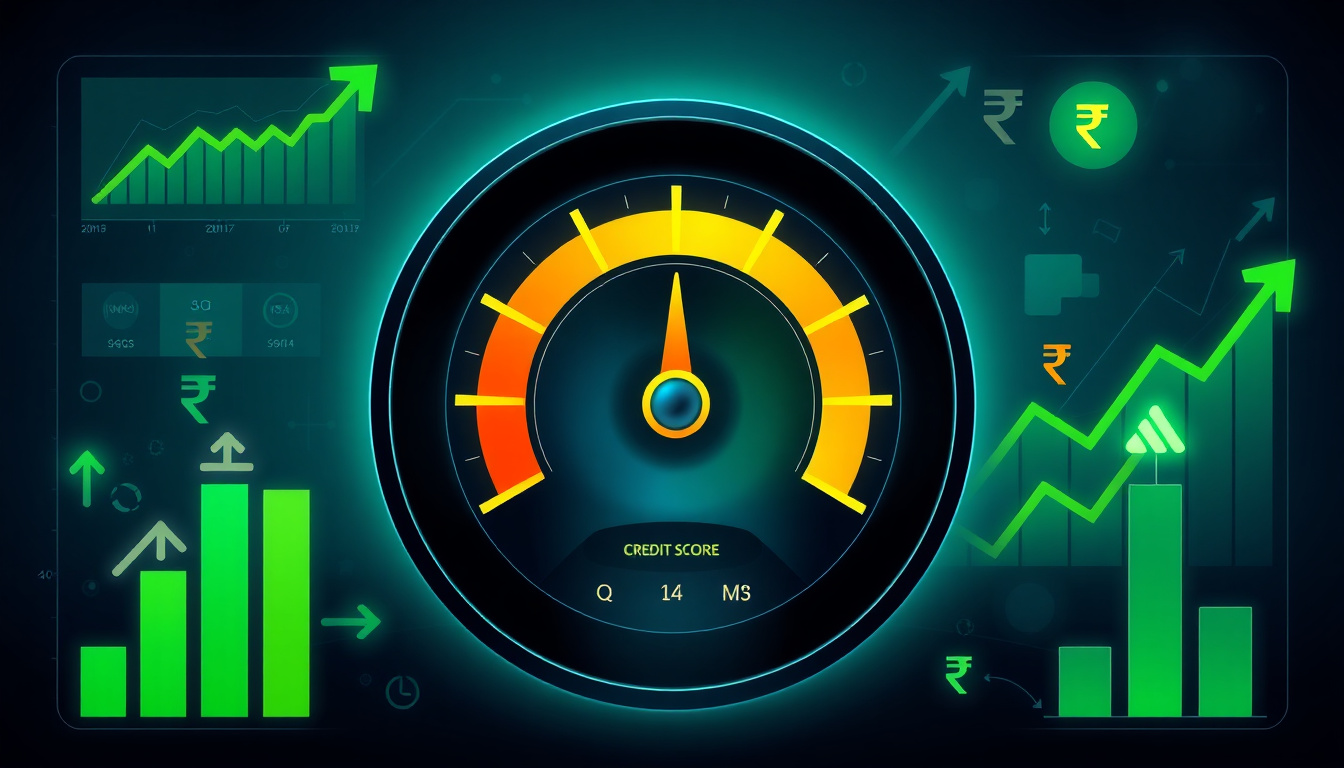
I didn't understand my credit score until I needed a loan.
Two years ago, I was looking at a ₹25 lakh home loan for a flat in Kalyan. The bank's relationship manager asked for my CIBIL report, and I realised I'd been completely ignoring this three-digit number that apparently controlled my entire financial life. My score was 710 — not terrible, but not great either. I'd never missed a payment. I had a credit card. So why wasn't it higher?
That day, sitting in the bank's office in Mumbai's Bandra Kurla Complex (I remember commuting back to Kalyan that evening feeling defeated), I decided to actually understand how this works. Not just the theory. The real mechanics. The numbers that matter.
Here's what I learned, and what I'll walk you through today.
What a Credit Score Actually Is (And Why Banks Care)
Let me start with the obvious thing nobody explains properly: a credit score is just a probability.
It's a three-digit number (typically 300–900 in India) that predicts the likelihood you'll default on borrowed money. Banks use it to decide whether to give you a loan, and at what interest rate. It's not a moral judgment. It's not about how responsible you are with money. It's purely predictive analytics — the same kind of work I do at Morningstar, actually, just applied to individual borrowers instead of markets.
In India, the four major credit bureaus (CIBIL, Equifax, Experian, CRIF HighMark) calculate your score using five key factors:
The Five Factors That Matter
Payment history (35%) — Have you paid your bills on time? A single missed payment can tank your score. This is the biggest factor. It's why my score wasn't higher despite having a clean account — I'd been late on a credit card payment once, in 2021, and that single instance dropped my score by about 40 points.
Credit utilisation (30%) — How much of your available credit are you using? If you have a ₹1 lakh credit limit and you're using ₹80,000, that's 80% utilisation. Banks see this as risky. They want to see you using less than 30% of what's available. This one surprised me. I was maxing out my credit card every month (and paying it off fully, which I thought was fine), but my utilisation was at 95%. My score suffered because of it.
Credit mix (15%) — Do you have different types of credit? A home loan, a car loan, a credit card — this variety is good. It shows you can manage different kinds of borrowed money. I had only a credit card and no other loans, which meant this factor was working against me.
Credit age (10%) — How long has your oldest credit account been open? Older is better. This one worked in my favour — my ICICI credit card had been open since 2015, which helped my score.
Inquiries and recent applications (10%) — Every time a bank checks your credit report (a "hard inquiry"), it can slightly lower your score. Multiple inquiries in a short period signal that you're desperately seeking credit, which is a red flag. I'd applied for three credit cards in six months in 2022, and each inquiry docked my score.
| Factor | Weight | What Helps Your Score | What Hurts It |
|---|---|---|---|
| Payment History | 35% | On-time payments, no defaults | Late payments, missed EMIs, settlements |
| Credit Utilisation | 30% | Using less than 30% of limit | Using 80%+ of available credit |
| Credit Mix | 15% | Multiple types of credit (loan + card) | Only one type of credit |
| Credit Age | 10% | Older accounts active on report | Closing old accounts, new profile |
| Inquiries & New Applications | 10% | Spacing out credit applications | Multiple hard inquiries in short time |
Understanding these five factors is the foundation. Once you know what's being measured, you can actually do something about it.
The Three Changes I Made (And What Actually Worked)
1. Fixed My Payment History (The Slowest But Most Important Fix)
Here's the honest part: you can't instantly fix a bad payment history. If you've missed payments, those marks stay on your report for 7 years. But I could prevent any future damage, and start rebuilding trust with lenders.
What I did: I set up autopay for everything. Not just the minimum payment — the full statement balance. Every credit card payment, every utility bill, every EMI. I use CRED for credit card payments (the app reminds you before deadlines and rewards on-time payments), and I set up autopay from my salary account for everything else.
The reason this matters: payment history is 35% of your score. A single late payment can drop your score by 50–100 points. Paying on time won't immediately boost it (the algorithm assumes on-time payments as the baseline), but it prevents damage and slowly builds your credit reputation. Over the 24 months after I started this, my score went from 710 to 745.
And honestly? That's the most boring, least exciting way to improve your score. But it's the only reliable way.
2. Dropped My Credit Utilisation Below 30% (The Fastest Win)
This was surprising to me. I was paying off my ₹1 lakh credit card limit completely every month. I thought I was a model customer.
But here's what the algorithm sees: On statement day (before the payment is processed), I'm at 95% utilisation. That's what gets reported to CIBIL. The fact that I pay it off a week later doesn't matter for the score.
So I made two changes:
First, I asked ICICI for a credit limit increase (from ₹1 lakh to ₹2.5 lakh). This instantly dropped my utilisation from 95% to 38%. My score jumped by 15 points within a month — before any payment history rebuild could happen.
Second, I stopped using my primary credit card for everything. I moved recurring expenses (Spotify, gym, AWS bills) to a separate card and paid them separately. This spread my utilisation across two cards, keeping both under 30%.
The lesson: utilisation gets reported as a snapshot on your statement date. Plan around it. If you usually spend ₹80,000 on your card, either ask for a higher limit or keep some spending on debit/cash.
3. Stopped Applying for Every Shiny New Card (The Hardest Habit to Break)
In 2022, every fintech was throwing cashback offers at me. A new card for groceries. Another for flights. HDFC, ICICI, Axis — each with a different reward structure.
I applied for three in six months. Each hard inquiry dropped my score by 5–10 points. By the time I realised what was happening, I'd already damage done. Multiple inquiries signal desperation for credit.
What I learned: each card application should be deliberate. Wait at least 3–6 months between applications. And honestly? You don't need more than two active credit cards. I have one premium card (for travel rewards) and one cashback card (for everyday spend). That's it. The others I closed, which also helped with credit mix (because closing cards can paradoxically improve your score by improving utilisation, but only if you've already reduced spending).
I used to think having more cards meant more options. Now I think it's noise. The banks care about your behaviour pattern — can you manage credit responsibly? Two cards with low utilisation and on-time payments tells that story better than five cards with scattered usage.
How to Monitor and Track Your Progress
You can't improve what you don't measure. So here's my system:
Monthly check: I log into CRED and check my credit score every month. It takes 30 seconds. This keeps me honest. The score usually changes by 5–10 points month-to-month, so I'm not obsessing over it daily.
Quarterly deep dive: Every three months, I get my full CIBIL report (you can pull it free from cibil.com or through apps like BankBazaar). I check for three things:
- Payment history: Are all my accounts marked "current"? Any late payments I don't remember?
- Utilisation: What's my balance-to-limit ratio on each card?
- Hard inquiries: Are there any applications I don't recognize?
Annual recalibration: Once a year (I do this in December), I review my credit goals. Am I planning to apply for a loan in the next 12 months? Do I need to increase my credit limit anywhere? Are there accounts I should close? This planning prevents last-minute scrambling when I actually need the credit.
The apps I use: CRED for credit card payments and score monitoring, BankBazaar for checking reports, and my bank's app for viewing statements and setting limits. I don't use fancy credit management apps because honestly, the data isn't that complex — you can track it in a Google Sheet if you want.
One more thing: if you see an error on your report (an account you don't recognize, a payment marked late when you paid on time), dispute it immediately. The bureau has to investigate within 30 days. I found one such error in 2023 (a mutual fund transaction wrongly marked as a loan payment), disputed it, and got it corrected in 45 days. That correction alone improved my score by 12 points.
My Perspective
Working at Morningstar, I spend my days looking at financial data — returns, risk, portfolio performance. I'm trained to think in patterns and probabilities. So when I started understanding credit scores, I realised it's the same logic: the algorithm isn't judging you; it's predicting your behaviour based on historical data.
What surprised me most was realising that credit score improvement is boring. It's not a hack or a secret. It's literally just: pay on time, use less credit than you have available, avoid applying for credit unless you need it. Those three things. For 24 months. That's what took my score from 710 to 785 (my current score as of last month).
I used to think I needed to understand complex strategies. But the data at Morningstar taught me something: the simplest systems often outperform the complicated ones. A rule-based approach (automatic payments, fixed utilisation limit, planned applications) beats any "clever" credit management strategy.
The one thing I got wrong: I thought on-time payment history alone would eventually push my score to 800+. But it won't. Payment history prevents damage; it doesn't accelerate improvement. Utilisation reduction and credit mix are what actually moved the needle for me. If you're starting from scratch (new to credit), I'd prioritise getting a mix of credit types first — a credit card plus any loan (even a small personal loan from your bank) — before obsessing over payment history.
Final Thoughts
Your credit score is one of the few three-digit numbers that actually matters in your financial life. It's not personality. It's not luck. It's a direct reflection of how you manage borrowed money.
The good news: you have complete control over it. You can't control market returns or inflation. But you can absolutely control whether you pay your bills on time, how much of your credit limit you use, and how often you apply for new credit.
Start with one thing. Maybe it's setting up autopay for everything (takes 20 minutes, prevents 95% of credit score damage). Maybe it's requesting a credit limit increase (one phone call, immediate impact). Maybe it's cutting back from five credit cards to two (stops the damage from multiple inquiries).
Do one thing this week. Then do it consistently. In 12 months, your score will be meaningfully higher — maybe not enough to impress anyone at a party, but enough to get you better interest rates, better card offers, and more loan options when you actually need them.
And if you're like me and ever find yourself sitting in a bank office trying to understand why your score isn't what you thought it was — at least now you'll have a plan to fix it.
Dattatray Dagale
Data Analyst • Blogger • Mumbai
I'm a data analyst from Kalyan, Maharashtra, working at Morningstar. I write about personal finance, career growth, and everyday life for Indian millennials — the stuff I wish someone had told me earlier.
Written by Dattatray Dagale • 28 July 2026


.png)
.png)


0 Comments