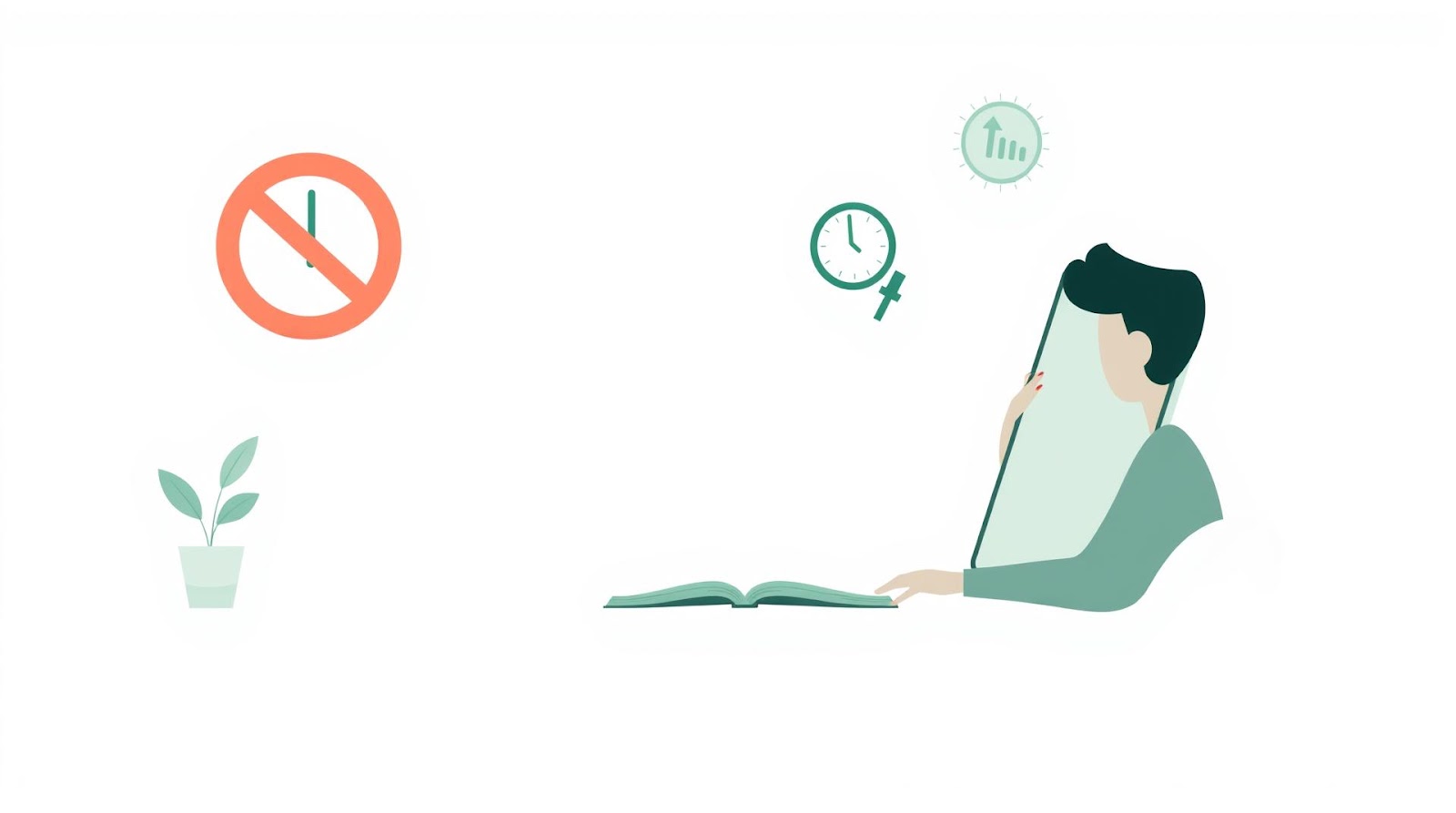
It was 3:47 AM on a Tuesday when I realized I'd been scrolling through Instagram Reels for two hours straight.
Not just casually. I was *deep* in it — past the point where the content made sense, past the point where I was even entertained. My eyes were dry. My neck hurt. And somewhere between a mukbang video and a stock market tip from someone with a DP of a luxury car they probably don't own, I'd completely lost track of time.
The worst part? I had a 9 AM client call the next morning.
I showed up looking like I'd survived a monsoon. The call didn't go well. And that's when I started doing the math — if doom scrolling was stealing 2-3 hours from my sleep, affecting my work performance, and indirectly costing me focus and money, what was the actual price tag on this habit?
Let me break it down: Lost sleep = worse decisions = missed opportunities. In my case, that particular call could've landed a ₹2 lakh project. Multiply that across a month of bad sleep, and you're looking at real money.
That's when I decided to actually do something about it instead of just feeling guilty about it.
Why Doom Scrolling Is Designed to Win Against You
Here's the thing — and I need you to hear this — doom scrolling isn't a character flaw. It's not something you're weak for doing. It's literally engineered.
The engineers and product designers at Meta, ByteDance, and Google have spent millions figuring out exactly how to keep you on the app. They've mapped your dopamine pathways. They've A/B tested the shade of blue that makes you tap fastest. They've timed the push notifications for maximum engagement.
You're not fighting a habit. You're fighting a $500 billion industry.
The Infinite Scroll Trap
Remember when apps had an "end"? Like, you'd refresh your feed and get the same posts over again, so you'd naturally close the app? That doesn't exist anymore.
The algorithm just keeps feeding you content. It learns what makes you pause. It knows if you lingered on a video for 3 seconds, and it'll serve you 50 more like it. Your thumb keeps moving. Your brain keeps waiting for the next hit. There's no finish line.
And honestly? That's the biggest trap. You think you'll scroll for 10 minutes, but there's no natural stopping point. So you keep going until either your phone dies or your eyes shut on their own.
The Doomscroll Versus Regular Scrolling
Now, not all scrolling is equal. Scrolling through your Zerodha portfolio? That's active, purposeful. Checking your WhatsApp chat? That's communication. But doomscrolling — watching 47 Instagram Reels, then jumping to Reddit, then back to YouTube Shorts — that's passive consumption with no real destination.
It's the digital equivalent of opening your fridge when you're not hungry and just staring inside hoping something interesting appears.
The Real Cost You're Not Calculating
Everyone talks about "lost time" when they discuss scrolling. And sure, that matters. But let me show you the bigger picture.
Sleep and Decision-Making
I use my phone at night. You probably do too. Blue light messes with melatonin production, which means worse sleep. Worse sleep means worse decisions the next day. This isn't theoretical — it's biology.
For someone earning ₹50,000-₹200,000 a month, a bad decision due to sleep deprivation could cost you project opportunities, client relationships, or just showing up as the worst version of yourself at work. I calculated that one bad client meeting cost me ₹2 lakh in potential revenue. How many times has that happened to you?
Comparison and Anxiety
Every scroll is someone else's highlight reel. Someone's gym photo. Someone's vacation. Someone's "how I made ₹10 lakhs in crypto" post (spoiler: they didn't). Your brain knows this logically, but it still feels real.
This creates a constant low-level anxiety. You start feeling like you're behind. Like you should be doing more. Like everyone's figured it out except you. That emotional tax is *real*, and it affects your motivation, your relationships, and your mental health.
The Opportunity Cost
If you scroll 2 hours a day, that's 14 hours a week. In a month, that's 60 hours. In a year, that's about 730 hours.
What could you do with 730 hours? Learn a new skill (probably 200-300 hours to get decent). Read 50 books. Build a side project. Spend actual time with people you care about. The list goes on.
And that's just the obvious stuff. The *real* cost is in the compounding — the person who uses those 730 hours to learn a skill that gets them a ₹5 lakh raise. That's generational wealth change, and it started with just not scrolling.
My 5-Step System to Actually Stop (Not Just Try)
I tried everything. Cold turkey doesn't work (your brain goes crazy). Time limits don't work (you just toggle between apps). Motivational posters don't work (you forget about them in 3 days).
What *did* work was removing friction for the behavior I wanted and adding friction for the behavior I didn't.
Step 1: Delete the Apps (Yes, Actually)
Not "take a break." Not "use app limits." Delete. Them.
I deleted Instagram, TikTok, Reddit, and YouTube from my phone. I kept them on my laptop, but here's the key — I only access them at my desk, during specific times, for specific reasons.
The friction is real now. I can't mindlessly scroll while waiting for coffee. I have to intentionally sit down and open a browser. That 5-second difference stops 90% of the urge.
If you're worried about missing important stuff — you won't. FOMO is a lie your brain tells you. No piece of information on Instagram is that urgent. If someone really needs to reach you, they'll WhatsApp.
Step 2: Replace the Habit, Don't Just Remove It
Your brain has a groove now. It reaches for the phone when bored, anxious, or waiting. If you just remove the app, you've created a vacuum. You'll fill it with something else (probably just opening a different app).
I replaced phone-scrolling with a book. Literally any book. When I feel the urge, I read 2-3 pages. It gives me the "something to do" without the dopamine trap. Other people use this time to journal, meditate, or just sit with their thoughts (I know, revolutionary).
Step 3: Use Your Phone Like You Use Your Wallet
You don't leave your wallet open on the table, right? Your phone shouldn't be constantly open in your hand either.
I now keep my phone face-down on my desk. It's out of sight, out of mind. Sounds stupid, but the barrier to checking it every 30 seconds is suddenly much higher. And when I do check it, I use my Focus Mode to block everything except essential apps (WhatsApp, Gmail, banking apps).
CRED, PhonePe, and Zerodha still work. Calls come through. But Instagram doesn't. And the moment you can't access something, you stop thinking about it.
Step 4: Track It (Because What Gets Measured Gets Managed)
For the first month, I tracked how much time I spent on each app using Screen Time. I didn't do anything with the data — just looked at it. That awareness alone cut my scrolling in half.
Seeing "2 hours on Instagram" in black and white feels different from vaguely knowing you scroll a lot. It's concrete. It's real. Your brain can't rationalize it away.
Step 5: Plan for Weak Moments
You will get bored. You will feel anxious. You will have moments at 11 PM where you desperately want to scroll.
Plan for this. Have a list of things to do instead: Read a chapter. Take a walk. Call a friend. Drink water. Journal. It sounds basic, but when your brain is screaming for dopamine, you can't think straight. Having a pre-made list is a lifesaver.
| Before (Doom Scrolling) | After (My System) | Impact on Life |
|---|---|---|
| 2-3 hours per day on apps | 20-30 minutes per day (intentional) | +14 hours/week for actual work or learning |
| Sleep at 2-3 AM (from scrolling) | Sleep at 11 PM | Better sleep = better focus = better decisions |
| Constant FOMO and comparison | Calm, intentional content consumption | Better mental health, less anxiety |
| Distracted during work | Deep work blocks (2-3 hours uninterrupted) | More productive = better work output |
| Half-read articles, forgotten ideas | Actually finish what I start | Real learning and knowledge accumulation |
The First Month Is Hard. Then It Gets Weird.
Week one: Your phone will feel like it's calling you. You'll have phantom vibrations. You'll reach for it out of habit and realize it's not there. This is normal. Your brain is literally rewiring itself.
Week two: You'll notice you're actually bored sometimes. Genuine, nothing-to-do boredom. This feels uncomfortable, but it's actually where creativity lives. Most people never get here because they fill every gap with scrolling.
Week three: You'll start noticing how much time you actually have. It's disorienting. Like someone gave you 14 extra hours a week that you didn't know you had.
Week four: You'll realize you don't even think about the apps anymore. They're not calling to you. You're not fighting urges. You've just... moved on.
And honestly? That's when the real changes start happening. I started writing more. Started reading books I'd been "meaning to" for years. Started having actual conversations with people instead of just being physically present while mentally scrolling. Started sleeping better, working better, thinking clearer.
And I definitely stopped missing out on the "important" stuff. Turns out nothing on Instagram is actually urgent.
Final Thoughts
I'm not anti-technology. I'm not saying you should live off-grid. I still use apps. I still consume content. The difference is that now *I* decide when, not the algorithm.
And that's the thing — this isn't about willpower or discipline or being "strong enough" to resist. It's about changing your environment so the default behavior is the behavior you want.
If you're reading this at 2 AM while scrolling, I'm not here to judge. I've been there. But I'm also here to tell you that there's a version of your life where you have 730 extra hours a year, better sleep, clearer thinking, and way less anxiety.
That version isn't theoretical. I'm living it. And it started with one decision: deleting the apps and deciding that my time was more valuable than the 0.005 seconds of dopamine each scroll gave me.
So maybe give it a shot? Not because I said so, but because your future self will thank you for it.
The 3 AM version of you definitely will.
Written by Dattatray Dagale • 22 April 2026



.png)
.gif)

0 Comments