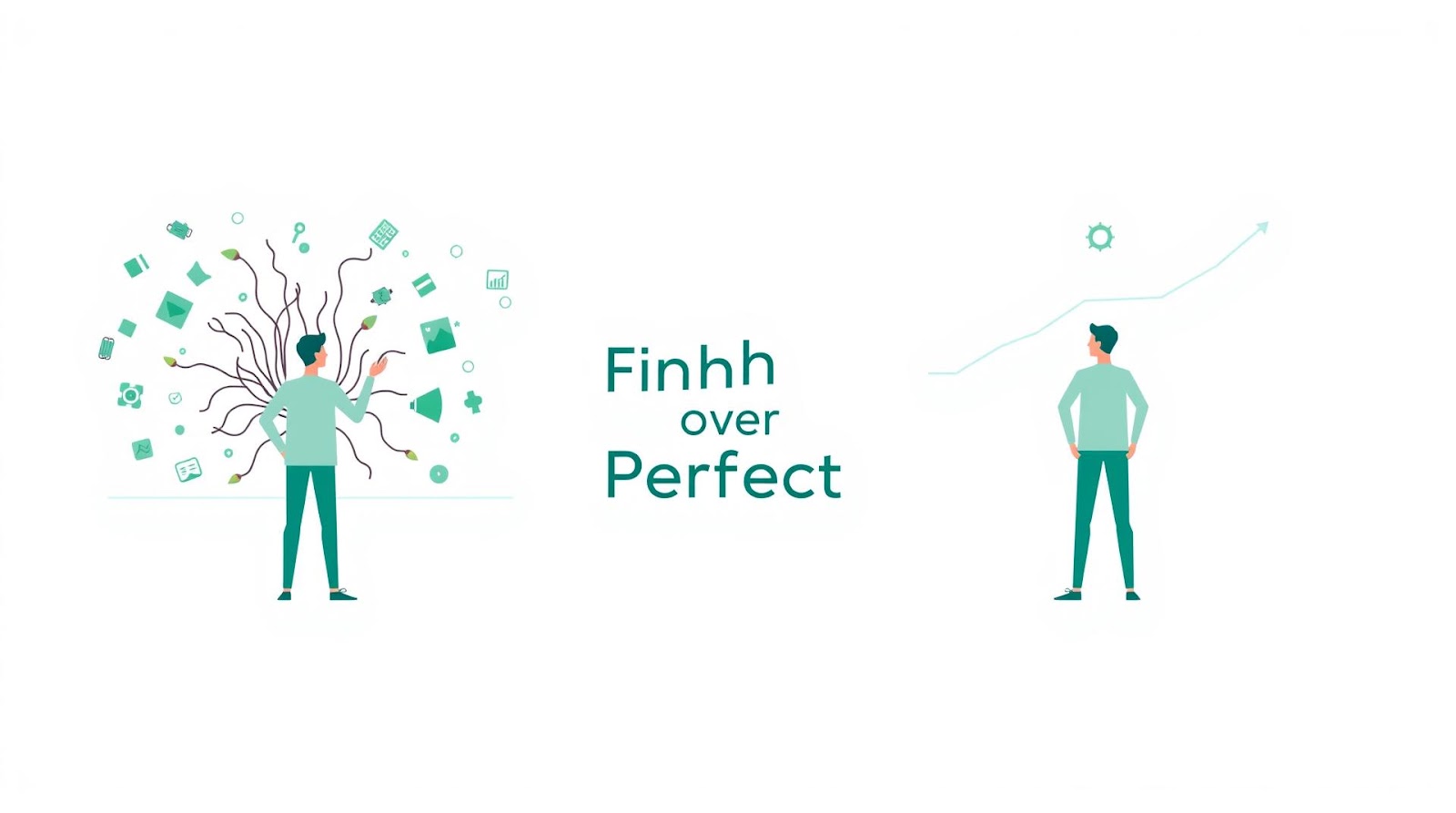
I was having coffee with a friend last month—let's call him Rohan—and he casually mentioned that he'd just got promoted for the third time in four years. Not because he was the smartest person in the room. Not because he had some secret MBA from abroad. He told me, "Datta, I just decided to finish things."
That stuck with me. Finish things.
Because here's what I've noticed after years of writing about money, habits, and career growth: most people—really, most of us—are incredibly talented at starting. We start side projects. We open a CRED account to "optimize our credit score." We buy a course on data analytics. We journal for three days straight. And then? We stop.
The gap between high performers and everyone else isn't talent. It's not even luck. It's a specific set of habits that look boring on paper but compound into something extraordinary over time.
Let me walk you through what I've actually observed (and tested myself).
Completion Over Perfection—The Real Differentiator
And honestly? This is where most of us mess up.
High performers—whether they're traders on Zerodha, freelance designers, or corporate managers—have one non-negotiable trait: they ship. They finish. They don't wait for perfect conditions, perfect ideas, or perfect execution.
I spent six months last year perfecting a spreadsheet model for tracking investment returns. I wanted the formulas to be elegant. I wanted the dashboard to be beautiful. I wanted to launch it as this polished thing. You know what happened? Nothing. The spreadsheet still lives in my Google Drive, half-finished, while three of my friends have already built similar tools and are actually using them to make better decisions.
High performers, though? They finish at 70% and iterate.
The "Done is Better Than Perfect" Paradox
This isn't about lowering standards. It's about redirecting your energy. When you finish something—even if it's rough—you get feedback. Real feedback. Not the imaginary criticism in your head. That feedback becomes your roadmap for the next version.
I know a content creator who publishes three mediocre LinkedIn posts a week instead of one perfect post every two weeks. Guess who has 50K followers? Guess who actually gets brand deals?
Completion compounds. Perfection stagnates.
The Practical Play: The "Minimally Viable" Approach
Here's what high performers actually do: they define the absolute minimum version of the thing. Not the dream version. Not the "if I had unlimited time" version. The minimum viable version.
Writing a book? Don't aim for 80,000 words. Aim for an essay. Publish it. Then expand. Building a side business? Don't perfect your entire business model. Make the first sale. Then iterate.
I started my blog with zero design sense and terrible grammar. But I published weekly. Now, five years later, tens of thousands of Indians read what I write. I couldn't have done that if I'd waited until I was "ready."
They Say No to Everything Except One Thing
This one surprised me.
I used to think high performers said yes to everything. Jump on every opportunity, right? Hustle harder, expand faster?
Wrong.
Every high performer I know—and I mean literally every one—is ruthlessly selective about where they spend time. They've mastered the art of saying no. Not in a rude way. Just... clearly.
A friend who runs a successful Shopify store told me his biggest breakthrough was stopping. He used to do content, paid ads, email marketing, SEO, affiliate programs. All of it. He was burnt out and his business was growing at 10% a month.
Then he picked one thing: email marketing to his existing customers. He said no to everything else for three months. Now? 40% month-on-month growth.
The "One Metric" Rule
Here's the framework: high performers pick ONE metric they're obsessed with. Not five. One.
For that Shopify founder, it was email open rates. For me as a writer, it's genuine reader feedback (not vanity metrics like follower count). For a stock trader, it might be win rate percentage, not total profit.
Everything else becomes a filter. Does this activity move the needle on that one metric? If not, it doesn't make the priority list.
This is why so many of us fail at building wealth. We're doing 15 things: tracking expenses in PhonePe, reading investment blogs, jumping between Zerodha and upstox, trying crypto, buying mutual funds, optimizing insurance, listening to multiple podcasts. We're spread so thin that none of it compounds.
The Permission to Ignore the Noise
Your manager asks you to lead a project. Your spouse wants you to join a fitness challenge. Your friend wants you to co-invest in a startup. Your LinkedIn feed is full of people launching side hustles.
High performers? They look at all of that and go: "Is this moving my one thing forward?"
If not, they politely decline. And they don't feel guilty about it.
That's the real power. Not having more discipline. Having the permission structure to ignore everything else.
They Build Systems, Not Motivation
Motivation is a lie.
I don't say that to be dramatic. I say it because high performers know it, and they structure their lives accordingly.
You know how I know someone is a genuine high performer? They don't talk about motivation. They talk about systems. They don't say, "I'm so motivated to invest in my future." They say, "Every Friday, ₹5,000 goes from my salary into a mutual fund. I don't think about it. It just happens."
Systems remove the need for willpower.
The Automation Habit
Here's what most people do: they manually transfer money to savings. They manually log expenses. They manually set reminders to journal, read, or exercise.
Here's what high performers do: they automate everything they can.
I automated my savings five years ago. Set up a recurring transfer to a separate savings account the day my salary hits. Now, I don't even see that money in my checking account. It just disappears. Best ₹20,000 per month decision I ever made.
Similarly, I have a recurring calendar block every Sunday for content planning. It's not inspiration-dependent. It's not motivation-dependent. The system handles it.
The Environment Design Principle
High performers also design their environment to make good choices easier and bad choices harder.
Want to eat healthier? Don't rely on willpower. Keep junk food out of your fridge. Keep salad ingredients visible. Make the good choice the path of least resistance.
Want to save more? Don't keep all your money in your main account. Split it. Keep your spending money small. Make spending harder, saving easier.
I use CRED for credit card bills because it gamifies the behavior. Points, cashback, rewards—all make me feel good about paying on time. Is it "necessary"? No. But it's smart design that makes the good habit the fun choice.
They Measure What Actually Matters
Here's the thing about measurement: everyone measures something. The difference is what they measure.
Most people measure vanity metrics. Social media followers. Years of work experience. Salary number. Hours spent in the office.
High performers measure leading indicators—things that actually predict future success.
Let me give you three examples from my own life:
Not vanity: I don't obsess over blog traffic numbers.
Actually matters: I track how many readers email me with real feedback or implementation stories.
Not vanity: I don't care about being called "expert" or getting featured in publications.
Actually matters: I track how many people say my writing changed their financial decision.
Not vanity: I don't track total investment returns (that's noisy and includes market factors I don't control).
Actually matters: I track how many smart investment decisions I made that quarter, regardless of outcome.
The Quarterly Review Ritual
High performers review their metrics regularly. Not obsessively daily (that's noise), but quarterly.
I do this every January, April, July, October. Three hours, a spreadsheet, actual thinking about what worked and what didn't.
Most people skip this entirely. They just keep doing what they've always done.
| What Most People Measure | What High Performers Measure |
|---|---|
| Salary (absolute number) | Salary growth % + skills acquired (leading to next raise) |
| Total investment portfolio size | Decision quality + consistency (savings rate, rebalancing discipline) |
| Hours worked | Output quality + work completed (not time spent) |
| Instagram followers | Engagement rate + DM quality (actual influence) |
| Years at current job | Skills acquired + opportunities created |
They're Obsessed With Learning From Failure
This is the one that separates the truly high performers from the merely successful.
Everyone fails. The difference is what happens next.
Most people fail and feel bad. They might even learn a generic lesson ("I should try harder next time"). Then they move on, carrying the same mental models into their next attempt.
High performers fail and become data scientists about their own failure.
I lost ₹45,000 on a stock investment four years ago. Most people would've said, "Investing is risky, I'm out." But I didn't. I obsessively analyzed what went wrong.
Was it the company I picked? (Bad due diligence)
Was it my entry price? (Yes, I FOMO'd in)
Was it my exit? (Yes, I panicked and sold at the worst time)
Was it my portfolio design? (Yes, I'd allocated too much to a single stock)
Now, five years later, that ₹45,000 taught me more about investing than a thousand rupees in "successful" trades would have. Because I extracted every lesson.
That's what high performers do. They extract lessons obsessively. They ask "why" until they find root causes, not surface explanations. And they update their system based on those lessons.
Final Thoughts
You want to know the honest truth? None of these habits are hard. None of them require special talent or expensive courses or a standing desk.
Finishing before perfecting? Easy.
Saying no? Simple.
Building a system? Takes maybe two hours.
Measuring the right things? Just requires thinking.
Learning from failure? It's literally free.
The reason most people don't do these things isn't because they're hard. It's because they're not glamorous. They don't make good LinkedIn posts. They don't look like hustle. They look like... being thoughtful and consistent.
And that's exactly why they work.
High performers understand something that most people don't: the game is decided by boring, consistent, intelligent systems—not by inspiration or luck or being "the hardest worker in the room."
So this week, pick one thing. Not all of them. One.
Maybe it's finishing something you've been perfecting. Maybe it's saying no to one commitment that doesn't move your one metric forward. Maybe it's automating one financial decision.
Start there. Then notice what changes.
That's how it compounds.
Written by Dattatray Dagale • 20 April 2026



.png)
.gif)



0 Comments