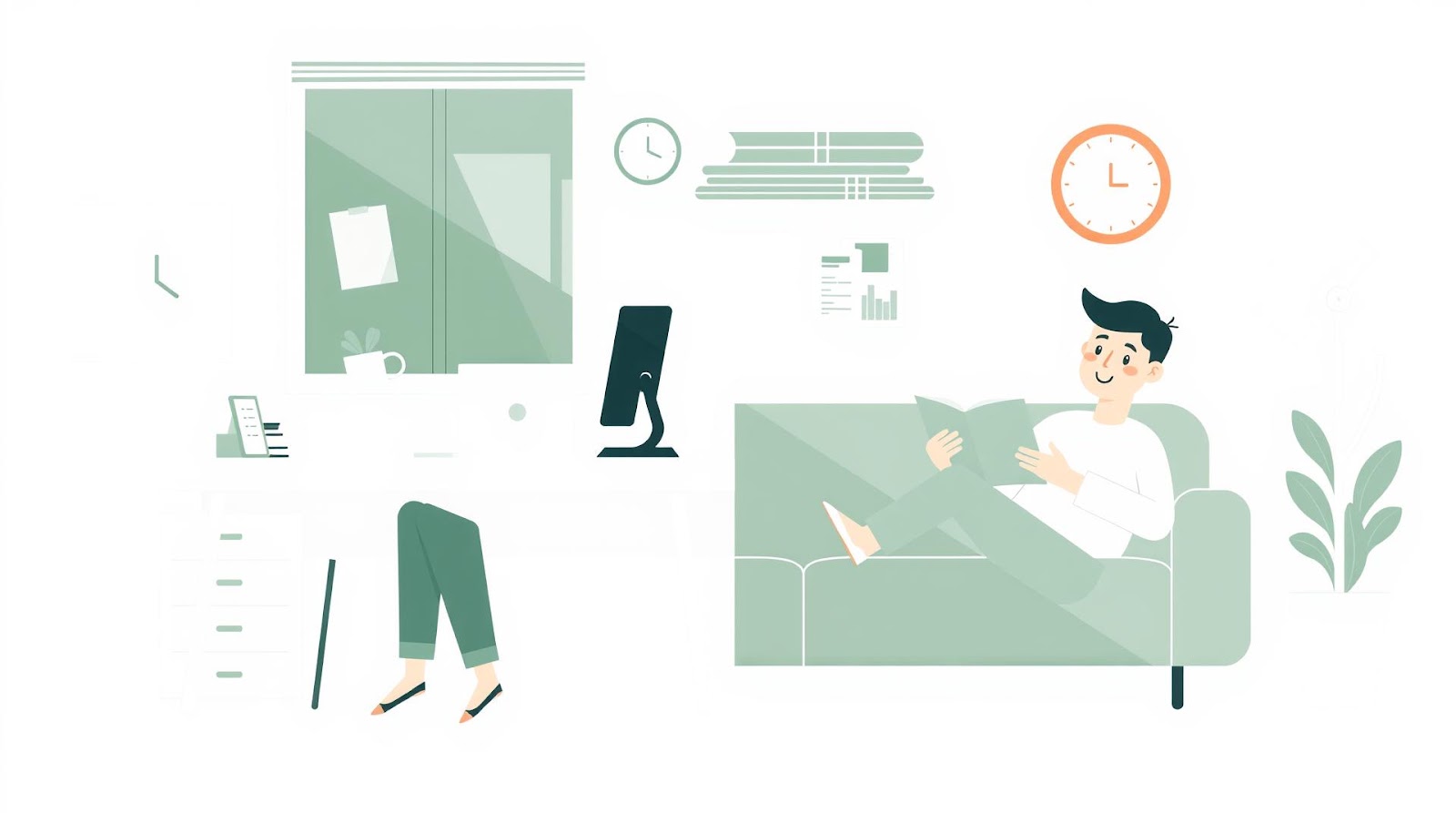
Last year, around 11 PM on a Wednesday, I was sitting at my desk with a cup of cold coffee, staring at a spreadsheet that genuinely didn't need me staring at it. My phone buzzed. My friend texted: "Still up?" I replied with a laughing emoji, but here's the thing — I wasn't laughing. I was exhausted. And the worst part? I'd convinced myself this was just "how it works" in the corporate world.
That night, something clicked. Not because I suddenly became enlightened or read a Tony Robbins book. It clicked because I realized I didn't actually know what work-life balance meant. And I'm willing to bet you don't either.
We throw around this phrase like it's some magic 50-50 split where you work exactly 8 hours, live exactly 8 hours, and sleep exactly 8 hours. Spoiler alert: that's not how life works. Especially not for Indian professionals juggling office deadlines, family expectations, side hustles on Upwork, and the existential dread of checking your salary against inflation.
So let me be straight with you — this isn't a post about perfectly balanced days. It's about what actually works.
What Work-Life Balance Actually Means (Spoiler: It's Not What You Think)
Here's the uncomfortable truth: perfect balance is a myth. A beautiful, Instagram-friendly myth, but a myth nonetheless.
Work-life balance isn't about creating two equal halves of your day. It's about creating a sustainable rhythm where your work doesn't completely cannibalize your health, relationships, and sanity — and simultaneously, your personal life doesn't sabotage your career growth.
Think of it like this: some days, work will take 60% of your energy. On those days, maybe you're launching a product, closing a big client deal, or prepping for a board meeting. That's fine. The balance doesn't happen on a daily basis. It happens over weeks and months.
The Real Cost of Ignoring It
I know this sounds dramatic, but hear me out. When you continuously prioritize work without checking in on yourself, something breaks. For me, it started small — I couldn't focus on conversations with friends. My relationship with money got weird (I was earning well but spending recklessly, almost like self-sabotage). Sleep became random. My Zerodha portfolio? I stopped tracking it because thinking about money made me anxious.
And honestly? That's when productivity actually *drops*. Studies show that burnout kills creativity, decision-making, and long-term performance. You're not being noble by grinding 12 hours a day. You're being inefficient.
It's Not About Hours, It's About Energy
Here's what changed for me: I stopped counting hours and started tracking energy.
Energy has seasons. A project deadline might mean high-intensity weeks. A health crisis in your family might mean you need to be mentally elsewhere. A new relationship might require presence. A creative block might mean you need to rebuild your confidence. None of these fit into a perfect schedule.
The best definition I've found? Work-life balance is about having enough margin in your life to handle the unexpected without collapsing.
The Three Pillars That Actually Matter
After experimenting for way too long, I found that sustainable balance rests on three things. Not ten productivity hacks. Not a perfect morning routine. Three actual pillars.
1. Boundaries (The Unsexy But Crucial One)
Setting boundaries feels rude, doesn't it? Especially in India, where hustle culture married family obligations and had toxic kids.
But here's what I learned: saying no to one thing is saying yes to something else. When I stopped answering Slack messages at 10 PM (except genuine emergencies), something weird happened — people stopped sending non-urgent messages at 10 PM. My brain got an actual off-switch.
This could mean:
- Not opening work email after 7 PM unless you're on-call
- Telling your manager you need one meeting-free day per week
- Having an actual phone-free dinner, not just a phone-face-down dinner
- Blocking calendar time for deep work so people stop ping-ponging meetings into your day
These sound small. They're not. They're the difference between feeling in control and feeling like a pinball in someone else's game.
2. Recovery (Not Just Sleep, But Real Recovery)
Sleep is non-negotiable, obviously. But recovery is bigger than that.
Recovery is the thing that makes you feel like yourself again. For some people, it's exercise. For others, it's creating something with their hands. For me, it's reading — something long-form and completely removed from my job — and cooking. Not healthy cooking. Actual cooking where I'm focused on technique and flavour, not calories.
And honestly? Recovery activities need to be scheduled. Not like a formal calendar block, but intentional. Because if you don't schedule it, your brain will fill that space with "just checking emails" or "just one more task."
I use PhonePe reminders (yeah, it's weird, but it works) to block off two hours on Sunday for cooking. Sometimes I actually stick to it. Sometimes I don't. But the intention matters.
3. Clarity on What You're Optimizing For
This one surprises people. But most of us don't actually know what we're trying to achieve with work-life balance.
Are you optimizing for money? Time with family? Creative fulfillment? Health? Learning? Because your answer changes everything.
If you're optimizing for money, maybe burnout for 2-3 years is a calculated choice (though I don't recommend it). But then own it. Don't pretend you're balanced while grinding 70-hour weeks.
If you're optimizing for time with family, you might turn down that promotion that requires relocating to Bangalore. If you're optimizing for learning, you might take a pay cut to work at a place with better mentors.
I realized I was optimizing for autonomy and intellectual challenge. Which meant saying no to safe jobs that paid more but required me to be in conference rooms for 8 hours a day. Once I knew that, decisions became easier.
Practical Systems That Don't Feel Like Work
Alright, so you understand the concept. But how do you *actually* live it?
Here are systems I've tried. Some stuck, some didn't. Your mileage may vary.
The Weekly Audit (30 Minutes, Every Sunday)
I spend 30 minutes on Sunday evening reviewing my week. Not obsessively — just asking:
- Did I spend time on things that matter to me?
- How many days did I feel energized vs. drained?
- What do I need to protect for next week?
This prevents the "wait, where did the month go?" feeling. You catch imbalances early.
Energy-Based Task Batching
Instead of "urgent/important," I categorize work by the energy it requires. High-energy tasks (strategy, creative work, client calls) go into my peak hours. Low-energy tasks (admin, email, expense reports) go into afternoon slots when my brain is fuzzy.
This means I'm not trying to do deep work at 4 PM when my cortisol has crashed. Revolutionary? No. Effective? Absolutely.
The "Two-Day Rule"
If I'm working late two days in a row, I protect the third day ruthlessly. Even if deadlines pressure me, I know that my productivity will tank anyway if I don't recover.
This is the math they don't teach you: day 1 late work + day 2 late work + day 3 destroyed productivity ≠ day 1 late work + day 2 late work + day 3 four hours of sharp work.
| Balance Approach | How It Works | Best For |
|---|---|---|
| Rigid Schedule (9-5 Hard Stop) | Same hours every day, complete separation | People who need clear boundaries; traditional office roles |
| Flexible Intensity (Seasonal Balance) | Some weeks are 60-40, others are 40-60, balanced over months | Entrepreneurs, consultants, creative roles |
| Energy-Based (Peak Hour Protection) | Protect high-energy hours for priorities; flex low-energy tasks | Knowledge workers, anyone doing focused work |
| Integration (Work + Life Blend) | No hard separation; work is part of life, life is part of work | People passionate about their work; remote workers |
The Money Part (Because It's Related)
And honestly? Work-life balance is deeply connected to financial health.
When you're living paycheck to paycheck with no emergency fund (thanks, Indian inflation), you can't afford to say no to anything. That bad project? You have to take it because you need the bonus. That job with unreasonable hours? You stay because leaving means 2 months without income.
Building financial breathing room is how you get actual freedom. Even ₹50,000 in a CRED savings account gives you options. A proper emergency fund (6 months of expenses) gives you power.
And I'm not saying this to sound preachy. I'm saying this because I couldn't truly balance my work and life until I had money saved. The moment I did, everything changed. Suddenly, I could negotiate. I could walk away. I could work on something meaningful even if it paid less.
Start small. Use an app like PhonePe to automatically transfer ₹2,000 every payday to a different account. You won't miss it. After 6 months, you'll have ₹12,000. After a year, ₹24,000. That's a safety net.
Final Thoughts
Work-life balance isn't a destination. It's not something you "achieve" and then coast. It's something you negotiate with yourself every week, every month, every season of your life.
Some phases of life are work-heavy. Career launches, startups, skill-building years — these require intensity. That's okay. But they should be finite. They should have an endpoint and a recovery plan.
Other phases are about depth in relationships, or creative exploration, or health recovery. Those matter too. They're not "taking a break from your career." They're building the foundation for your next chapter.
And here's what I wish someone had told me earlier: you don't have to prove yourself by being miserable. The grind culture that celebrates 70-hour weeks? It's often masking insecurity. Real competence is doing great work in fewer hours. Real leaders are those who protect their teams' energy. Real success includes being able to have dinner with people you love without thinking about spreadsheets.
So start small. Pick one boundary. Protect one recovery activity. Get clear on what you're actually optimizing for. The rest will follow.
And hey, if you figure out something that works, come tell me about it. I'm still experimenting too.
Written by Dattatray Dagale • 16 April 2026



.png)
.gif)


0 Comments