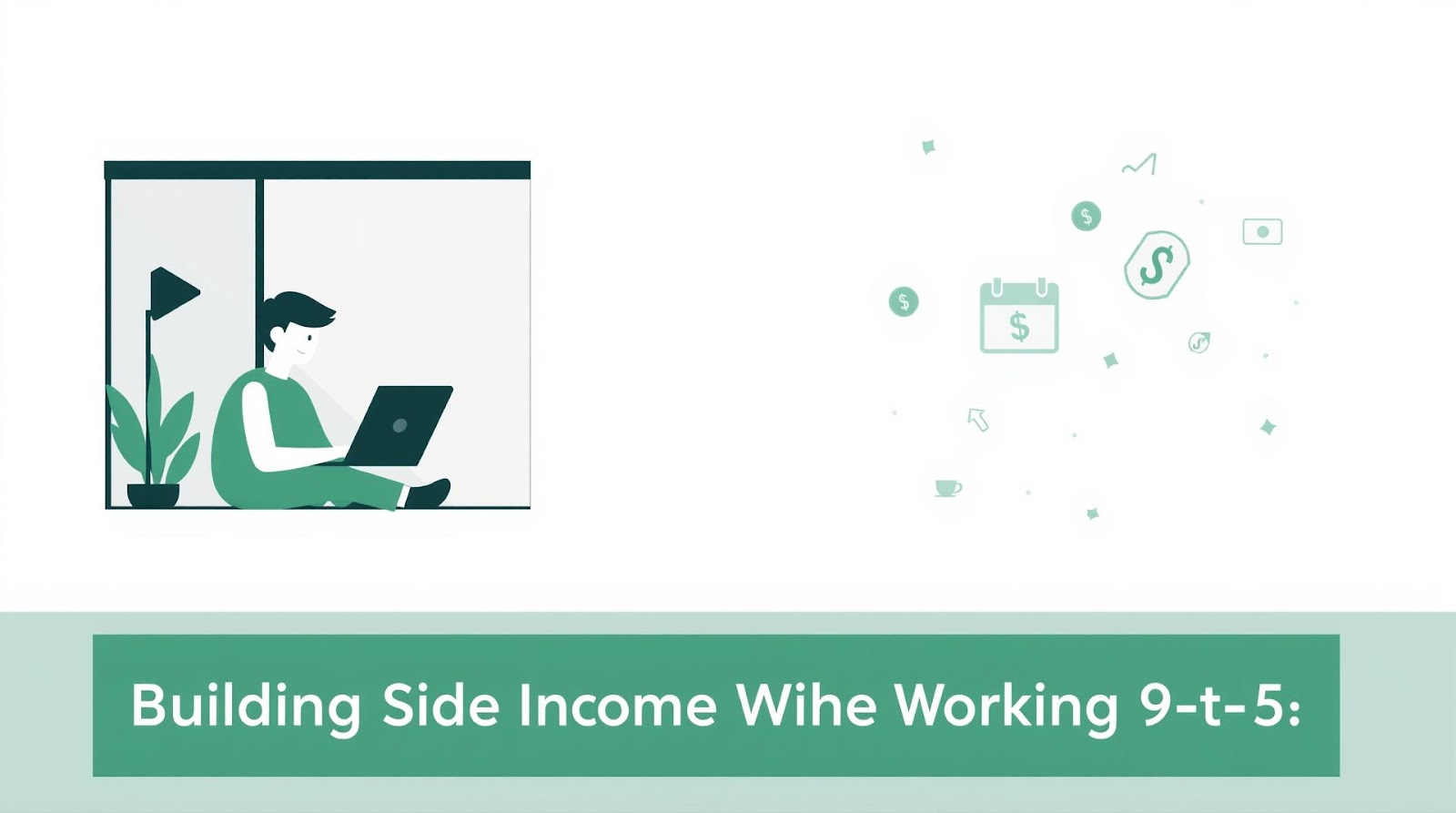
Let me start with the uncomfortable truth: I was broke-ish even though I had a "good job."
My salary was decent — around 65K a month after taxes. But after rent in Mumbai, gym, coffee addiction, and occasional guilt-driven dinners with friends, I had maybe 8-10K left. That's not a rainy day fund. That's a wet tissue fund.
So around 2019, I decided to stop complaining and actually build something. Not because I'm some grind-culture zealot (I hate that energy, honestly). But because I wanted more control over my money, my time, and my future. Over the next three years, I tried roughly seven different side income ideas. Three of them stuck. Two made real money. One actually changed how I think about work.
This isn't a "I made ₹10 lakhs in your spare time" story. Those are usually lies. But it's real — and I think you'll find it useful.
The First Rule Nobody Tells You: You Can't Just "Find Time"
Here's the thing that kills most side hustles before they start — people think time appears if you stop watching Netflix. It doesn't.
Time is a zero-sum game when you're working full-time. Every hour you spend on a side project is an hour you're NOT sleeping, NOT with friends, NOT on hobbies that actually rest your brain. And your brain needs rest to do your day job well.
So the first decision isn't "which side hustle should I start?" It's "what am I actually willing to sacrifice?" And you need to be honest. Brutally honest.
The Energy Audit That Changed Everything
I started tracking not just my time, but my energy. I realized my brain was sharp from 6-8 AM and 8-10 PM. The afternoon was dead. Weekends felt too precious to treat like work days.
So I made a simple rule: I'd only build side income during my peak hours using energy I wasn't already using. No sacrificing sleep. No replacing gym time.
This single decision eliminated about 80% of the "opportunities" I was considering.
The Lifestyle Math
Before starting anything, calculate your real hourly opportunity cost. If you make ₹65,000 a month, you're not making ₹250 per hour. You're making ₹250 after tax, after work stress, after traffic. Your actual hourly value is lower — maybe ₹150-180 after accounting for life costs.
Any side income idea that pays less than ₹300-400 per hour (roughly ₹5,000+ per week for 12-15 hours) probably isn't worth your mental energy. That's the baseline I use.
The Three Side Hustles That Actually Worked
1. Freelance Writing (The Slow Burner)
I started writing for finance blogs in 2019. First article paid ₹2,000. I spent 8 hours on it. Do the math — it was terrible.
But here's what nobody tells you about creative side hustles: the compounding isn't linear. By month 4, I had regular clients paying ₹8,000-12,000 per article. By month 8, I was turning down work. By year two, I had clients who'd wait months for my availability.
The secret? I picked ONE platform (Medium first, then direct client relationships), built credibility there, and didn't spread myself thin across 10 platforms like everyone else does.
Today, writing brings in ₹40-60K some months. But it took 8 months of feeling like I was wasting time before it became real money.
2. Data Analytics Consulting (The High-Ticket Play)
This was accidental. A former colleague asked if I'd help her startup analyze their customer data. I quoted ₹25,000 for a weekend project. She said yes without negotiating.
That hurt me and helped me simultaneously. I realized I was underpricing.
Within six months, I was doing 2-3 consulting projects per quarter at ₹40-80K each. These projects took real time — maybe 20-30 hours spread over 4 weeks. But the hourly rate was suddenly ₹1,500-2,000+.
The catch? I only got here because I was already good at my day job. I was leveraging skills I'd spent years building. You can't just start consulting in something you learned from YouTube.
3. Teaching Online (The Surprising Winner)
And honestly? This surprised me the most.
I started teaching a data course on Unacademy in 2021, charging ₹99 per month. I expected 10 students, maybe 20. Got 150 in the first month.
The beautiful part: once the course is recorded, income becomes mostly passive. Each month, I spend maybe 3 hours answering student questions. The course generates ₹18-25K monthly without much additional effort.
The ugly part: building the course took 60+ hours upfront. And teaching online requires a different skill than knowing the subject — it's about explaining clearly, handling difficult students, and constantly updating content.
What I Tried and Why It Failed
Let me be straight with you — I also tried:
Dropshipping (2019): Made ₹2,000 in three months while investing ₹5,000. Never again. Saw some people make real money, but it requires daily engagement and the margins are razor-thin in India.
Content on YouTube (2020): Spent two months making videos, got 32 subscribers. Realized I hated being on camera and had no unique angle. Quit.
Stock Trading (ongoing disaster): Lost ₹18,000 trying to be a day trader. Every rupee made was purely luck, and I was checking Zerodha every 15 minutes. Not worth the stress.
The pattern? Things that required me to be constantly present, things that competed with my day job mentally, or things that didn't leverage existing skills — all failed within 3-6 months.
The Actual Framework (What I Use Now)
After all this, here's the framework I'd follow if starting again:
| Stage | Timeline | Goal | Realistic Income |
|---|---|---|---|
| Validation (Months 1-2) | 5-8 hours/week | Prove people will pay for this | ₹0-5K |
| Systematize (Months 3-6) | 10-15 hours/week | Build a repeatable system | ₹5K-15K |
| Scale (Months 7+) | 10-20 hours/week | Reach passive or high-margin revenue | ₹20K-80K+ |
The validation phase is crucial and everyone skips it. You spend 1-2 months just proving someone will actually pay. Not building the whole thing. Just proving demand exists.
Most side hustles die in validation because there's no actual demand. But the ones that pass validation almost always work, because you've already found your customer.
The Practical Stuff Nobody Mentions
Taxes (The Annoying Part)
Here's what I wish someone had told me: side income is taxable. All of it. Even if it's freelance gigs through CRED or PhonePe transfers.
If you're making more than ₹50K annually from side income, you technically need to file it in your ITR. I didn't do this initially (stupid, I know), and it gave me stress until I regularized everything.
Now I set aside 30% of side income directly into a savings account. It's not scientific, but it works.
The Burnout Cliff
There's a point between month 4-6 where side income stops feeling exciting and starts feeling like a job. This is when 80% of people quit.
You need something to push through: either the money needs to be real enough to feel meaningful, or the work needs to be enjoyable enough to not feel like punishment. Ideally both.
For me, the writing stayed interesting because I loved it. The consulting became real money. The teaching hit both notes. The dropshipping had neither — so it died.
Your Day Job Matters
This is the part everyone misses. You can't build a strong side income if your day job is draining you completely. If you're exhausted, burnt out, or hate your work, side hustle energy goes to zero.
Before starting any side income, honestly evaluate your day job. If it's actively destroying you, fix that first. The best side income strategy is a tolerable day job + something you can build in the gaps.
Final Thoughts
I've been doing this for about five years now. Right now, my side income averages ₹70-80K monthly across all three streams. It's not "quit my job" money, but it's changed how I think about security, how I spend, and what I'm capable of.
The money matters, but honestly? The bigger shift is that I no longer feel trapped by my salary. If my day job becomes intolerable, I have options. If I want to take a sabbatical, I can. If I want to negotiate harder, I'm not desperate.
That psychological shift is worth more than the actual rupees.
If you're thinking about building side income, here's my honest advice:
Start small. Spend this week identifying one skill you have that people actually pay for. Ask three people if they'd buy it. That's your validation.
Don't spread thin. Pick one thing. Do it well. Only after it's generating real money, consider a second stream.
Protect your sleep. No side hustle is worth chronic tiredness. If you're exhausted, you're not optimizing, you're just torturing yourself.
Track the time honestly. If something isn't hitting your ₹300+ per hour threshold by month 4, kill it and move on. Don't sunk-cost fallacy yourself.
And remember — everyone who built something meaningful started exactly where you are. Broke-ish, ambitious, and wondering if it's actually possible.
It is. But it takes longer than the Instagram ads say.
Written by Dattatray Dagale • 19 April 2026



.png)
.gif)



0 Comments